Grocery · Tool and printable
Pantry-first grocery list
Quick answer
Write down everything the week's dinners use, with amounts. Before you leave, check the shelf and write what you have. Buy only the gap: what the week needs, plus what you want left on the shelf, minus what is already there, rounded up to whole packages. In the worked example, 4 of 10 lines come off the list before the store.
Source: no outside figures. This tool works only from what you enter.
Try it
Filled in with the worked example below. Change any number and the result updates.
Your shopping list 6 lines instead of 10. The shelf already covers 4 (40% of the list).
- Partly on the shelf, so buy less
- 3
- Restock only
- 1
- Rounded up to whole packages
- 2
The list, by store section
Meat, seafood and tofu
- Chicken thighs: buy 3 lb (none on the shelf)
Dairy and eggs
- Eggs: buy 1 pack of 12 eggs (you have 4 eggs; 8 eggs left after the week)
Bread and bakery
- Tortillas: buy 1 pack of 10 tortillas (you have 6 tortillas)
Pantry and dry goods
- Dry pasta: buy 1 lb (you have 1 lb)
- Broth: buy 2 packs of 4 cups (8 cups) (none on the shelf; 2 cups left after the week)
- Olive oil: buy 1 bottle (restock: keep 1 bottle on the shelf)
Already on the shelf: leave these off
- Onions: have 5 each, the week uses 4 each
- Rice: have 3 lb, the week uses 1.5 lb
- Canned tomatoes: have 4 cans, the week uses 3 cans and you keep 1 can
- Frozen vegetables: have 2 bags, the week uses 2 bags
Every line, in your order
| Item | Week needs | On hand | Keep after | To buy | Left after the week |
|---|---|---|---|---|---|
| Onions | 4 each | 5 each | none | skip | 1 each |
| Chicken thighs | 3 lb | 0 lb | none | 3 lb | 0 lb |
| Eggs | 8 eggs | 4 eggs | none | 1 pack of 12 eggs | 8 eggs |
| Tortillas | 16 tortillas | 6 tortillas | none | 1 pack of 10 tortillas | 0 tortillas |
| Dry pasta | 2 lb | 1 lb | none | 1 lb | 0 lb |
| Rice | 1.5 lb | 3 lb | none | skip | 1.5 lb |
| Broth | 6 cups | 0 cups | none | 2 packs of 4 cups (8 cups) | 2 cups |
| Canned tomatoes | 3 cans | 4 cans | 1 can | skip | 1 can |
| Olive oil | 0 bottle | 0 bottle | 1 bottle | 1 bottle | 1 bottle |
| Frozen vegetables | 2 bags | 2 bags | none | skip | 0 bags |
Step by step, no jargon
How to use this, in plain words
- 1
Start from the week's dinners. Go through each one and write every ingredient it needs, with an amount, one line per item.
- 2
Walk to the pantry, fridge and freezer with the list. Next to each line, write what you already have, in the same unit.
- 3
For things sold in packages, look at the size printed on the front of the package you usually buy (a dozen eggs, a 10-count bag of tortillas) and enter it.
- 4
For staples you never want to run out of, fill in "Keep after" with what should still be on the shelf when the week ends.
- 5
Read the list by store section, then print it. Lines the shelf already covers are left off.
Before you start
- Check the shelf right before you shop, not the night before. Someone always uses the last of something in between.
- Count opened packages honestly. Half a bag of rice is half a bag, so measure or weigh it.
- Use the same unit in every box on a line. If the recipe says cups and the bag says pounds, pick one and convert first.
- Keep the "Keep after" amounts small. They're for the few things you would hate to run out of, like oil or salt.
The method
How it works
- For each item, use one unit for every amount: cans, pounds, cups or a count.
- Gap = what the week needs + what you want left after the week − what is on the shelf now. A gap of zero or less means the item comes off the list.
- If the item comes in packages, divide the gap by the package size and round up. Packages to buy = the gap ÷ the package size, rounded up to a whole number.
- Left after the week = on hand + what you buy − what the week uses. Rounding up is why some items leave a spare.
- The list is grouped by store section in the same order as the weekly dinner plan: produce, meat, dairy, bakery, pantry, frozen.
Step by step
Worked example
A household of four has planned the week's dinners and written down 10 lines. Before shopping they check the shelf. They want one can of tomatoes and one bottle of olive oil left over when the week ends, and they buy chicken loose at the counter.
- Write every item the week's dinners use, with the amount, then check the shelf: 10 lines, 9 of them for this week's dinners and 1 restock line.
- Chicken thighs: 3 − 0 on hand = 3 lb; bought loose, so exactly that.
- Eggs: 8 − 4 on hand = 4 eggs; 4 ÷ 12 = 0.333, rounded up to 1 package (12 eggs).
- Tortillas: 16 − 6 on hand = 10 tortillas; 10 ÷ 10 = 1, so 1 package (10 tortillas).
- Dry pasta: 2 − 1 on hand = 1 lb; 1 ÷ 1 = 1, so 1 package (1 lb).
- Broth: 6 − 0 on hand = 6 cups; 6 ÷ 4 = 1.5, rounded up to 2 packages (8 cups).
- Olive oil: 0 + 1 keep − 0 on hand = 1 bottle; 1 ÷ 1 = 1, so 1 package (1 bottle).
- Covered by the shelf, so off the list: Onions (5 on hand ≥ 4), Rice (3 on hand ≥ 1.5), Canned tomatoes (4 on hand ≥ 3 + 1 kept), Frozen vegetables (2 on hand ≥ 2). That is 4 of 10 lines = 40%.
- Rounding up leaves extra: 4 + 12 − 8 = 8 eggs after the week.
Figure
Put it on the fridge
What to record
Your household
Variants
Five-minute check
Only check the pantry and freezer lines, the ones that keep. Produce, meat and dairy get bought fresh for the week anyway, so leave their On hand boxes empty.
Staples with a floor
Give oil, flour, rice and canned tomatoes a "Keep after" amount of one package. The list tells you to restock the week you dip below it, before you run out.
Holiday stocking
Before a big meal, put the holiday dinner's items on the list together with the normal week's dinners. The shelf check catches the cans and spices you bought last year.
Two stores
Set the store section to match where you buy it: pantry for the warehouse store, produce for the market. The list prints grouped, so each trip has its own block.
Limitations
- Planning estimate; check package sizes on the shelf, since the same item comes in different sizes at different stores.
- Amounts come from your own recipes and your own counting. The tool only does the subtraction and the rounding.
- We don't say how long food keeps on the shelf or in the freezer. For that, check the USDA FoodKeeper app.
Checking the result
If the answer surprises you
Buying more than the gap? Packages round up. If you need 6 cups of broth and cartons hold 4, you buy 2 cartons and keep 2 cups.
An item you own still shows up? You entered a "Keep after" amount, so the tool keeps that much aside for after the week.
Your list looks the same as before? Check the On hand boxes. An empty box counts as zero.
Asked often
Questions
How do I make a grocery list from what I already have?
List the week's dinners first, then every item they need. Check the shelf for each line and write what you have. Buy only the difference, rounded up to whole packages. The tool does that subtraction for you and drops the lines the shelf already covers.
What does "Keep after" mean?
It is how much of an item you want left on the shelf when the week is over. Set it for staples you never want to run out of. Leave it empty and the tool lets the week use up everything you have.
Why does the list tell me to buy more than I need?
Because stores sell whole packages. If you need 8 eggs, have 4 and eggs come by the dozen, you buy 12 and have 8 left after the week.
Should I check the fridge and freezer too?
Yes, anything the week's dinners use. The freezer is where forgotten bags of vegetables hide. For how long a frozen or opened food keeps, use the USDA FoodKeeper app; we don't give storage times.
Source: FoodKeeper App, FoodSafety.gov, checked October 6, 2026.
How much does a pantry check save?
It depends on how full your shelf is. The tool shows how many lines came off your list, so you can see it for your own week. In the worked example it was 4 of 10.
Read next
Guides that go deeper
 Know-how · 5 min readWhy the receipt and the cost per serving never matchA pot of chili costs $20.90 by the serving but $38.61 at the register. The gap is the part of each package the pot didn't use. Here's how to read both numbers.Read the guide
 Problem-solving guide · 6 min readDoubling a recipe for a crowd: the shopping-list sideFeeding 12 from a recipe for 4? Scale every line, total each ingredient across dishes, subtract the pantry and round up to packages once. Chart included.Read the guide
 Problem-solving guide · 6 min readGrocery bill keeps creeping up: a weekly routine that worksWhy grocery totals drift up week after week, and a short weekly routine to catch it: plan dinners, shop the pantry, buy from one list, log the receipt.Read the guide
 Know-how · 5 min readUnit price: how to compare sizes in the store in 10 secondsRead the unit price on the shelf tag, fix mismatched units in your head, and spot when the bigger package loses. Includes a pocket card to print.Read the guide
 Problem-solving guide · 6 min readFive dinners from one grocery trip: how to plan the week so the list holdsCook three nights, eat five: double two bases, put the fresh dinners first and the pantry ones last, and keep one shelf dinner as the backup.Read the guide
 Know-how · 5 min readMy child buys lunch on pizza day. How do I plan the rest of the week?Untick the days a child buys at school and the lunch sheet recounts. What a part-week does to the shopping list, the leftovers and the week's lunch money.Read the guide
The whole job
Systems that use this tool
This tool is one part of a finished routine. The system page puts it in order with the other steps.
 SystemWeekly planning · 8 steps · free printableCook once, eat twice: one big batch, two or three dinnersPick one plain base, count servings for every dinner it feeds, cook it once, split it before the sauce and route the rest by date. Free double-batch card.Open the system
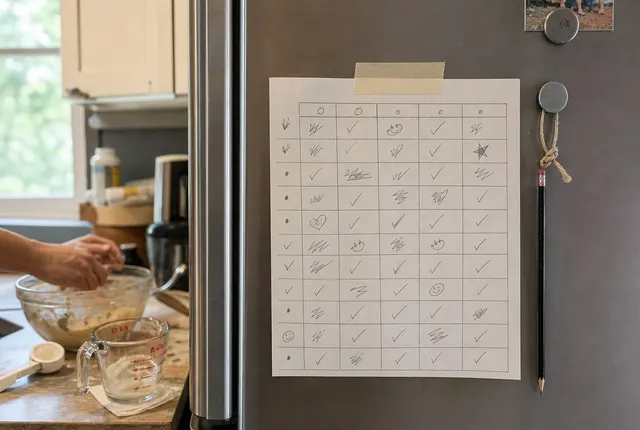 SystemRotations · 8 steps · free printableThe four-night theme rotation: one dinner card for the whole seasonFour theme nights, two to four dinners you already make under each, three open nights and one standing grocery list. Set it up once, reuse it all season.Open the system
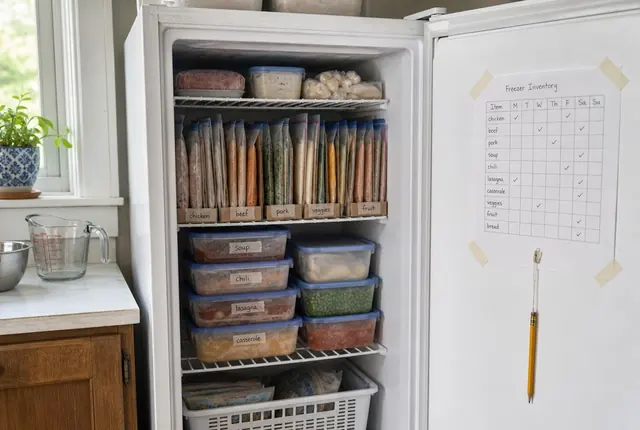 SystemPantry and freezer records · 8 steps · free printableThe freezer inventory: one sheet on the door, oldest food eaten firstCount every bag in your freezer once, sort the list oldest first, tape it to the door and plan freezer dinners into the week. Free printable sheet.Open the system
 SystemHolidays and gatherings · 7 steps · free printableFriendsgiving and potluck sign-up: who brings what, and how muchRun a Friendsgiving or potluck from one sign-up sheet: slots in fill order, every dish sized to the headcount, turkey math and heat needs. Free printable.Open the system
 SystemShopping and budget · 7 steps · free printableShop your own shelves before the storeWrite the week's list, check the pantry, fridge and freezer against it, and buy only the gap in whole packages, grouped by aisle. Free printable check list.Open the system
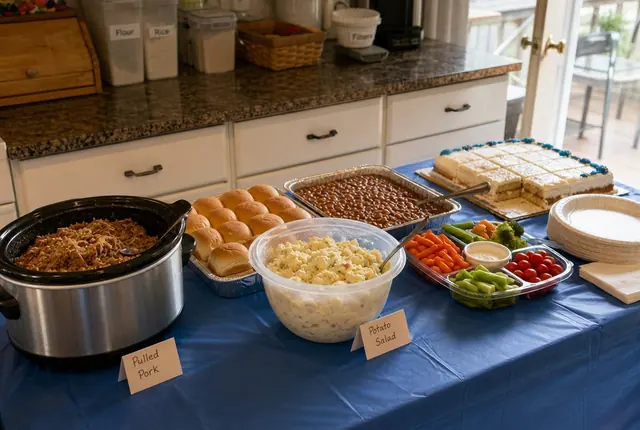 SystemHolidays and gatherings · 7 steps · free printableParty food quantities: how much to make per guest, and the list it turns intoHow much food for a party: plan 1 to 1½ pounds per guest, count 60% of invites for an open house, then turn ounces per guest into a list. Free printable.Open the system
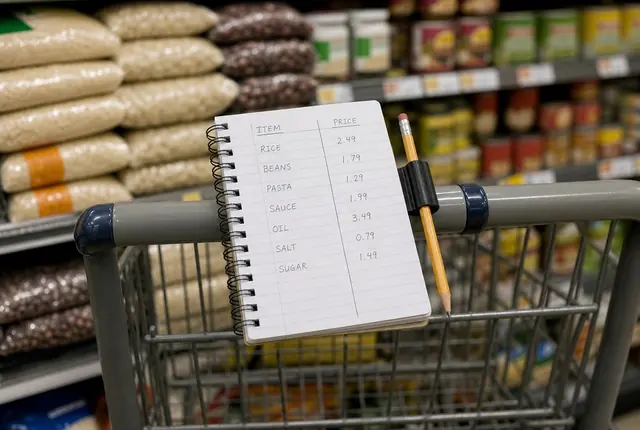 SystemShopping and budget · 7 steps · free printableThe grocery price book: know a good price before you reach the shelfWrite down the unit price of your 20 most-bought groceries for four weeks, circle the lowest, and stock up only when a tag matches it. Free printable page.Open the system
 SystemHolidays and gatherings · 7 steps · free printableThanksgiving week: easy nights before, leftover nights afterPlan the nine nights around Thanksgiving: light dinners while the oven and fridge are busy, then leftover nights you count from the turkey. Free printable.Open the system
 SystemWeekly planning · 7 steps · free printableGet weeknight dinners back on track in three weeksGet weeknight dinners back after summer or any break: map the new schedule, clear the fridge, plan three known dinners, then build up. Free printable.Open the system
Keep planning
Related tools
- OccasionsHoliday dinner timeline plannerList each dish with its oven setting and minutes. Get a dated countdown for the days before and a timeline for the day, counted back from serving time.Open the tool
- GroceryStore comparison worksheetPrice your monthly staples at up to three stores and see the cheapest store, the cheapest way to split the list, and whether a club fee pays off.Open the tool
- GroceryMonthly grocery trackerLog each grocery receipt, keep non-food items apart, and see what's left per day and per week. Weekly checkpoints and a printable receipt log.Open the tool
- FreezerFreezer inventory and labelsList what's in the freezer, see it sorted oldest first, count how many dinners the cooked dishes cover, and print an inventory sheet with labels.Open the tool
- PlanWeekly dinner plan generatorPlan seven dinners as cook, leftover, assemble and flex nights, rotate four dish types, and print the week with a grocery list by store section.Open the tool
- GroceryPrice per unit calculatorCompare grocery prices by the ounce, pound, fluid ounce or item, including multi-packs and 2-for deals, then print a price book page.Open the tool
- GroceryGrocery budget calculatorWork out a weekly and monthly grocery budget for your household from the USDA Food Plans cost tables, then print a monthly spending tracker.Open the tool
- FreezerPantry inventory and restock listCount the pantry shelf by shelf, set a restock point and a full level for each staple, and print the inventory with a restock list sorted by zone.Open the tool
Checked and dated
Sources
- FoodKeeper App, FoodSafety.gov (USDA Food Safety and Inspection Service). Checked October 6, 2026.
See every source on the site on the sources page. Spotted an error? Tell us.