System · Weekly planning
Weeknight time budget: put each dinner on the night that has time for it
Quick answer
For each night, subtract the time the cook gets home from dinner time. That's the window. Then add up what the dinner needs: hands-on minutes, minus anything chopped ahead, plus the oven or simmer time dinner still waits for. If the need is bigger than the window, move some chopping to a weekend prep session, swap the dinner with a longer night, or pick a quicker one. Then write a start time on every night. The US time use survey puts food preparation and cleanup at about 43 minutes a day for the average American in 2025. Use it as a reference line for your own week.
Source: American Time Use Survey 2025, Table 1, BLS, checked October 14, 2026.
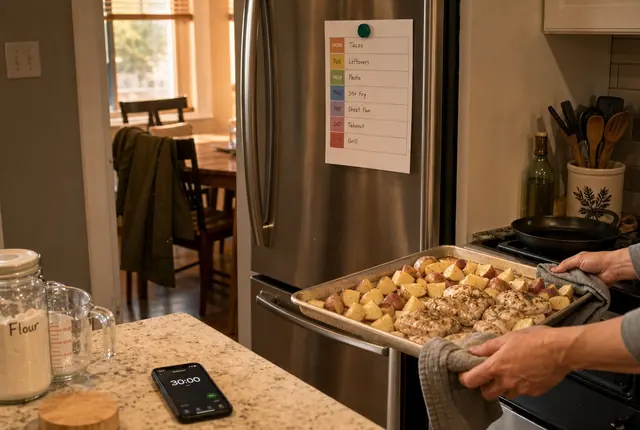
- 45 vs 60 minWednesday in the worked example: home at 5:45 for dinner at 6:30, and the stir-fry needs 40 hands-on + 20 for the rice
- 15 minof Wednesday's chopping moved to the Sunday prep session, which then holds 40 of its 60 minutes
- 240 minkitchen time for the planned week: 125 on the nights + 25 on Sunday's prep session + 6 cleanups × 15, about 34 a day
- 43 mina day on food preparation and cleanup, the 2025 average for Americans 15 and over (about 65 on days with any)
Source: American Time Use Survey 2025, Table 1, BLS, checked October 14, 2026.
Part 1
The decision first
Do it yourself
Budget the week's minutes
Home times change from night to night (practice, late shifts, a long commute), dinner often lands late, or the plan has dinners with long oven or simmer times.
Skip it
Skip the budget
Everyone is home with an hour or more before dinner every night and dinners already land on time. Keep using the weekly dinner system and come back when the schedule changes.
Get help
Get help instead
How long chopped or cooked food keeps before the night you use it, and whether an oven or slow cooker can run while nobody is home, are food safety questions: use the USDA FoodKeeper app and FoodSafety.gov. Medical diets and allergies need a registered dietitian or your doctor. This system plans minutes.
Part 2
The steps, in order
Set dinner time and cleanup
Pick the time dinner goes on the table on an ordinary weeknight and how long cleanup usually takes. The worked example eats at 6:30 pm and cleans up in 15 minutes. If you don't have a plan yet, make one first with the weekly dinner plan.
Have readyThe household calendarThe week's dinner plan
Write each night's home time
Use the time the cook is home with their coat off, not the time work ends. Minutes free = dinner time − home time. In the example: Monday 5:30 gives 60, Tuesday 6:00 gives 30, Wednesday 5:45 gives 45, Thursday 6:15 gives 15, Friday 5:00 gives 90, Sunday 4:30 gives 120, and Saturday they're out.
Have readyWork, school and activity schedules
Split each dinner into hands-on and hands-off
Hands-on is time at the counter or stove. Hands-off is the oven, the simmer or the rice cooker. Dinner still waits for it, so it counts. Sheet-pan chicken is 15 + 30 = 45, not 15. Your own timed attempt beats a recipe's estimate. Hands-on vs hands-off minutes works through four dinners.
Have readyA phone timerYour planned dinners
Run the time budget
Needs = hands-on − minutes done ahead + hands-off, and start by = dinner time − needs. The weekly cooking-time budget does this for all seven nights. In the example, Wednesday's stir-fry needs 40 + 20 = 60 minutes in a 45-minute window: 15 over, with a 5:30 start the cook can't make.
Have readyThe weekly cooking-time budget
Fix every night that runs over
Three fixes, in this order. Move up to the overrun to the prep session (Wednesday's 15 minutes of chopping go to Sunday). Swap with a night where both dinners fit (Monday's 60 or Friday's 90). Or put a quicker dinner or a leftover night there. Home at 6, dinner at 6:30 fixes a whole week by swapping.
Have readyThe list of nights with spare minutes
Plan the prep session
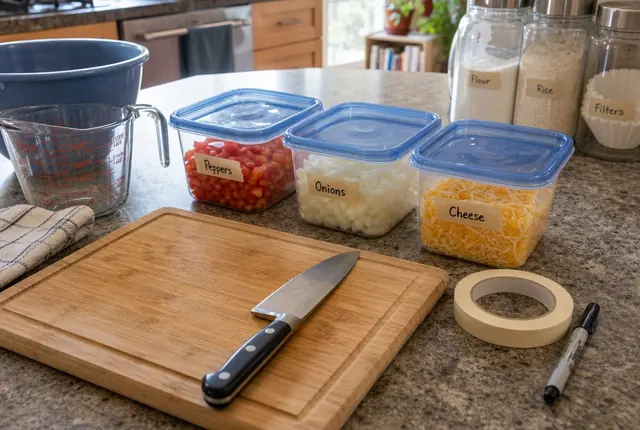
List what each night hands to the session: 10 minutes of taco toppings, 15 of pizza toppings and now 15 of stir-fry vegetables, 40 of Sunday's 60 minutes. Only chopping, measuring and mixing count. Look up how long each item keeps in the USDA FoodKeeper app and write the use-by on the container.
Have readyOne weekend slotContainers and labels
Post the start times
Write a start-by time on every night and put the sheet next to the dinner plan: Monday 5:45, Tuesday 6:15, Wednesday 5:45 after the move, Thursday 6:20, Friday 5:55, Sunday 5:00. Whoever gets home first can see when the oven goes on.
Have readyThe printed time budget sheetA fridge magnet
Add up the week and log the real minutes
Kitchen time for the example week is 125 minutes on the nights + 25 in the prep session + 6 cleanups × 15 = 240, about 34 a day. The 2025 survey average is about 43 minutes a day for every meal and snack, so a dinner-only plan should come in under it. Through the week, write the minutes each dinner really took and use them next week.
Have readyA pencil at the stove
Source: American Time Use Survey 2025, Table 1, BLS, checked October 14, 2026.
Figure
The tools in this system
Let the tools do the arithmetic
- PlanWeekly cooking-time budgetEnter when you get home and the minutes each dinner takes. See which nights run over, when to start, and what to move to a prep session or swap.Open the tool
- PlanWeekly dinner plan generatorPlan seven dinners as cook, leftover, assemble and flex nights, rotate four dish types, and print the week with a grocery list by store section.Open the tool
- Cook onceCook once, eat three plannerPlan one base, like shredded chicken or a pot of beans, for three dinners: how many batches to make, what to buy, how to split it, plus a card and labels.Open the tool
Part 3
What goes wrong
What happens when you skip a step, and how to catch it.
Counting only hands-on minutes
A sheet-pan dinner with 15 minutes of prep looks like a 15-minute dinner. It needs 45 with the oven time, so on a 30-minute night it's late by 15.
Using the time work ends
The commute, the school pickup and the coat on the hook eat the first part of the window. Plan from the time someone can actually start cooking.
An overbooked prep session
If the nights hand more done-ahead minutes to Sunday than Sunday has, the chopping doesn't happen and every one of those nights runs over at once. Add up the session before you count on it.
The long dinner on the short night
Chili with an hour on the simmer lands on Thursday because that was the chili night last month. Put the longest dinners on the longest windows first, then fill the short nights.
Recipe times taken on trust
Printed prep times rarely count getting pans out, preheating and finding the cumin. Time one ordinary dinner with a phone timer and use that number.
Part 4
Variants that change the steps
No prep session
Leave the prep session out and every done-ahead minute goes back to its night. Overruns then get a swap or a quicker dinner. A leftover night on the shortest window often fixes the week by itself.
Two cooks
Use the earliest home time of anyone who can start dinner. One person heats the oven or starts the rice, the other does the hands-on part when they're home, so the hands-off minutes can run before the second cook gets home.
Home after dinner time
A night where the cook gets home after dinner time has 0 minutes free. Make it a leftover night or a no-cook dinner, or move dinner later on that night's row and write the new time on the sheet.
Cook-once weeks
One long Sunday cook turns the weeknights into short reheat-and-assemble rows. The cook once, eat twice system plans the batch, and this budget checks the nights it feeds.
Figure
From the kitchen table
Tips and tricks
Fill the longest windows first. Put the dinner with the most hands-off time on the night with the most minutes free, then work down to the shortest night.
Keep one leftover night or assemble night for the shortest window of the week. It needs about 10 minutes and rescues the night that would run over.
Move chopping to the prep session, not cooking. Chopped onions and measured spices save hands-on minutes on the night without changing the dinner.
Write start times as clock times, not minutes. "Oven on at 5:45" is easier to act on than "needs 45" when you walk in the door.
Keep a running list of your own times: dinner, hands-on, hands-off. After two or three weeks you can plan most of the week without timing anything.
Recommendation
What we would do
Start with this week's plan as it is and only run the budget. Fix the nights that run over with swaps first, because swaps cost no extra time. Add a prep session only for the nights a swap can't fix, and keep it under an hour. Time two dinners during the week and put your own numbers in next Sunday.
Part 6 · Free, one page, US Letter
Print the working copy
Time budget sheet
- The nights
- The arithmetic
- Prep session
- Before the week
- End of week
Planned for the store: the full Weeknight Time Budget Kit, a binder of time budget sheet: seven nights, needs, start-by, fits or over, prep session sheet: tasks by night, minutes, use-by from foodkeeper, fix list: move to prep, swap nights, quicker dinner, my dinner times: hands-on, hands-off, last made, two-cook week: who starts, who finishes, no-prep-day week: swaps and leftover nights only.
Part 5
The primary source
U.S. Bureau of Labor Statistics, published June 25, 2026. Checked October 14, 2026.
The Bureau of Labor Statistics runs the American Time Use Survey. Table 1 of the 2025 results gives food preparation and cleanup at 0.71 hours a day for everyone 15 and over and 1.09 hours on the days people did any. We use it as a reference line for the week's total. We read the table on October 14, 2026.
Asked often
Questions
How much time should I budget for dinner on a weeknight?
Whatever the night has: the minutes between getting home and dinner time. Check each dinner against that window, counting hands-off time too. For a reference, Americans 15 and over spent about 43 minutes a day on food preparation and cleanup in 2025, and about 65 minutes on the days they did any.
Source: American Time Use Survey 2025, Table 1, BLS, checked October 14, 2026.
What's the difference between hands-on and hands-off cooking time?
Hands-on is time you're busy at the counter or stove. Hands-off is time the food is in the oven, simmering or in the rice cooker. You're free during hands-off time, but dinner still waits for it, so a night's need is both added together, minus anything done ahead.
What can I do ahead in a weekend prep session?
Chopping, measuring, mixing sauces and dressings, and grating cheese all cut hands-on minutes on the night. How long each prepped item keeps is a food safety question: look it up in the USDA FoodKeeper app and write the use-by on the container.
Source: FoodKeeper App, FoodSafety.gov, checked October 6, 2026.
What if I get home after dinner time?
That night has no minutes free. Plan a leftover night or a no-cook dinner there, or set a later dinner time for that one night and write it on the sheet.
How do I find my real cooking times?
Start a phone timer at the first pan and stop it when the food is on the table, and note when you were free during it. Do it for two or three regular dinners and use those numbers in place of the recipe's estimates.
Read next
Guides in this system
 Problem-solving guide · 6 min readHome at 6, dinner at 6:30: how to match each dinner to the night that has time for itA 60-minute dinner on a 30-minute night runs late. Measure each night's window, add up what each dinner needs, and swap the ones that don't fit.Read the guide
 Know-how · 5 min readHands-on vs hands-off minutes: why a 15-minute sheet-pan dinner takes 45A recipe's prep time is only the hands-on part. Dinner also waits for the oven. How to count both, when they overlap, and which one fills your evening.Read the guide
 Know-how explainer · 6 min readMeal planning for beginners: your first week in 20 minutesNew to meal planning? Plan one week of dinners in 20 minutes: check the calendar, look in the fridge, give each night a job and write one grocery list.Read the guide
Checked and dated
Sources
- American Time Use Survey, 2025 Results, Table 1: Time spent in primary activities, averages per day by sex, 2025 annual averages, U.S. Bureau of Labor Statistics. Checked October 14, 2026.
- FoodKeeper App, FoodSafety.gov (USDA Food Safety and Inspection Service). Checked October 6, 2026.
Planning and arithmetic only, not nutrition, dietary, food-safety or financial advice. See every source on the sources page. Spotted an error? Tell us.