Grocery · Tool and printable
Store comparison worksheet
Quick answer
Price the same items at each store, turn every shelf price into a price per unit, then multiply by how much you use in a month. In the worked example the discount grocer is the cheapest single store at $57.18 for eight staples. Buying the chicken at the supermarket brings it to $54.18. The warehouse club saves $4.48 a month on this list, which doesn't cover its $5.00 monthly share of a $60 fee.
Source: no outside figures. This tool works only from what you enter.
Try it
Filled in with the worked example below. Change any number and the result updates.
Cheapest way to buy these 8 items Discount grocer and Supermarket: $54.18 a month
Best single storeDiscount grocer at $57.18. Splitting the list across 2 stores saves $3.00 a month for 1 extra stop.
- Everything at Discount grocer
- $57.18
- Everything at Warehouse club (with $5.00 a month of the fee)
- $57.70 +$0.52
- Everything at Supermarket
- $71.48 +$14.30
Item by item
| Item | Discount grocer | Supermarket | Warehouse club |
|---|---|---|---|
| Eggs 24 count a month | $0.24 / count $5.78lowest | $0.33 / count $7.98+38.1% | $0.27 / count $6.49+12.3% |
| Milk 2 gallon a month | $2.99 / gallon $5.98lowest | $3.79 / gallon $7.58+26.8% | $3.15 / gallon $6.29+5.2% |
| Long-grain rice 5 lb a month | $1.25 / lb $6.23+63.9% | $1.65 / lb $8.23+116.6% | $0.76 / lb $3.80lowest |
| Chicken thighs 6 lb a month | $1.99 / lb $11.94+33.6% | $1.49 / lb $8.94lowest | $1.79 / lb $10.74+20.1% |
| Canned tomatoes 8 count a month | $1.19 / count $9.52lowest | $1.89 / count $15.12+58.8% | $1.25 / count $9.99+4.9% |
| Shredded cheese 2 lb a month | $4.38 / lb $8.76+4.4% | $5.98 / lb $11.96+42.5% | $4.20 / lb $8.39lowest |
| Bananas 6 lb a month | $0.49 / lb $2.94lowest | $0.69 / lb $4.14+40.8% | $0.50 / lb $2.98+1.4% |
| Olive oil 17 fl oz a month | $0.35 / fl oz $6.03+49.9% | $0.44 / fl oz $7.53+87.4% | $0.24 / fl oz $4.02lowest |
| Ground coffee 24 oz a month | no price | $0.75 / oz $17.98+79.9% | $0.42 / oz $9.99lowest |
Each cell shows the price per unit, then the cost of what you use in a month (price per unit × amount). A big package lasts more than a month, so this is the fair monthly figure, not the cash at the register.
Not in the totals, because a store has no price for it: Ground coffee (missing at Discount grocer; lowest so far Warehouse club, $9.99 a month).
Every way to split the list
| Shop at | Stops | Items | Fee share | Month | Vs cheapest |
|---|---|---|---|---|---|
| Discount grocer and Supermarket | 2 | $54.18 | - | $54.18 | cheapest |
| Discount grocer, Supermarket and Warehouse club | 3 | $49.37 | $5.00 | $54.37 | +$0.19 |
| Supermarket and Warehouse club | 2 | $50.90 | $5.00 | $55.90 | +$1.72 |
| Discount grocer and Warehouse club | 2 | $51.17 | $5.00 | $56.17 | +$1.99 |
| Discount grocer | 1 | $57.18 | - | $57.18 | +$3.00 |
| Warehouse club | 1 | $52.70 | $5.00 | $57.70 | +$3.52 |
| Supermarket | 1 | $71.48 | - | $71.48 | +$17.30 |
Warehouse club fee check. On these items it saves $4.48 a month against Discount grocer, so $53.76 a year against a $60.00 fee: $6.24 short. It takes about 14 months of this basket to earn the fee back. Only the items on this list count, so add the other things you'd buy there before you decide.
Shopping list for the cheapest plan
- Discount grocer$52.43 at the register
- Eggs: 2 × 12 count at $2.89
- Milk: 2 × 1 gallon at $2.99
- Long-grain rice: 3 × 2 lb at $2.49 (1 lb left for next month)
- Canned tomatoes: 8 × 1 count at $1.19
- Shredded cheese: 4 × 8 oz at $2.19
- Bananas: 6 × 1 lb at $0.49
- Olive oil: 2 × 16.9 fl oz at $5.99 (16.8 fl oz left for next month)
- Supermarket$8.94 at the register
- Chicken thighs: 6 × 1 lb at $1.49
Step by step, no jargon
How to use this, in plain words
- 1
List the things you buy every month, and how much of each you go through, like 24 eggs, 2 gallons of milk or 5 lb of rice. Your last few receipts are the quickest way to find them.
- 2
At each store, copy the shelf price and the package size printed on the label. For meat and produce sold by the pound, type the price per pound and a size of 1 lb.
- 3
Add the yearly membership fee for any store that charges one. It's printed on the card or the renewal receipt.
- 4
Read the cheapest split at the top, then the item table to see which store wins each item and by how much.
- 5
Print the comparison. The shopping list at the bottom says what to buy where and how much cash each stop takes this month.
Before you start
- Compare the same thing at every store: same kind of rice, same egg size, same cheese. A store brand against a name brand is a different test.
- Use regular shelf prices, not this week's sale, unless the sale price comes back often. One sale can make a store look cheaper than it is.
- Put in what you really use in a month, not what the big package holds. A bulk bag only saves money if you finish it.
- A second stop costs time and gas. If the split saves only a dollar or two a month, one store is probably the better plan.
The method
How it works
- Price per unit = shelf price ÷ package size, with the size turned into the unit you count the item in (16 oz to a pound, 128 fl oz to a gallon).
- Cost of what you use = price per unit × the amount you go through in a month. A 25 lb bag of rice counts only for the 5 lb you use this month.
- Store total = the cost of what you use, added up over the items every store prices, plus a month's share of any membership fee (yearly fee ÷ 12).
- Split plan = each item at the store in the plan with the lowest price per unit. The tool tries every combination of stores and ranks them by month total. A fee only counts when the plan buys something at that store.
- Fee check = (cheapest other store's total − this store's items) × 12, against the yearly fee.
- At the register = packages you need to cover the month (rounded up) × shelf price. Big packages cost more cash today and leave stock for next month.
Source: NIST Handbook 44 (2026), Appendix C, checked October 10, 2026.
Step by step
Worked example
Two adults price eight things they buy every month, plus coffee, at three stores near them. The prices are one week of shelf tags: eggs, milk, rice, chicken thighs, canned tomatoes, shredded cheese, bananas and olive oil. The warehouse club charges $60 a year. The discount grocer doesn't sell their coffee, so that cell stays empty. These are sample prices; yours will differ.
- Price per unit = shelf price ÷ package size. Eggs: $2.89 ÷ 12 = $0.24 each at Discount grocer, $6.49 ÷ 24 = $0.27 at Warehouse club.
- Cost of what you use = price per unit × the month's amount. Rice, 5 lb a month: $6.23 at Discount grocer, $3.80 at Warehouse club. The club's 25 lb bag still costs $18.99 at the register and lasts 5 months.
- Add the 8 items that have a price everywhere: Discount grocer $57.18, Warehouse club $52.70, Supermarket $71.48. The club's $60.00 yearly fee adds $60.00 ÷ 12 = $5.00 a month, so its total is $57.70.
- Best single store: Discount grocer, $57.18. Best split: Discount grocer and Supermarket, $54.18, which is $3.00 less. Adding the club as a third stop comes to $54.37, because the fee share is more than the club saves on this list.
- Fee check: the club saves $4.48 a month against Discount grocer, so $53.76 a year, $6.24 short of the $60.00 fee. Coffee isn't in the totals, since Discount grocer has no price for it.
Figure
Put it on the fridge
What to record
Your household
Variants
Two stores only
Leave the third store empty. The tool compares the two and shows whether splitting the list between them saves anything.
Club fee shared with family
If two households split one membership, type your share of the yearly fee. The fee check then uses only what you pay.
Online order against the store
Use the delivery or pickup prices as one store and add any yearly delivery membership as its fee. Per-order delivery charges aren't in the math, so add them to the item prices if you pay one every time.
Check one aisle at a time
Start with the ten things you buy most. Those are the items where a price gap adds up fastest, and you can add more rows next month.
Published figures
Numbers this tool uses
| Figure | Value | Source, date checked |
|---|---|---|
| 1 pound | 16 ounces = 453.59237 g | NIST Handbook 44 (2026), Appendix C, October 10, 2026 |
| Pint, quart, gallon | 16, 32 and 128 US fluid ounces | NIST Handbook 44 (2026), Appendix C, October 10, 2026 |
| 1 US fluid ounce | 29.57353 mL | NIST Handbook 44 (2026), Appendix C, October 10, 2026 |
Limitations
- Planning estimate; check the shelf tags again every few months, since prices and sizes change.
- Gas, time and delivery charges for an extra stop aren't in the totals. Weigh them yourself against the split saving.
- Numbers only, not advice. The tool compares the prices you type and doesn't say which store or membership to choose.
Checking the result
If the answer surprises you
The warehouse club wins most items but still loses? Its fee share counts against every month. On a short list the per-unit savings can be smaller than the fee.
The register total is far above the monthly figure? Bulk packages cost more cash on the day. The monthly figure spreads that cost over the months the package lasts.
An item is missing from the totals? It needs a price at every store to count in the comparison. It still shows in the item table with its cheapest store so far.
Asked often
Questions
Is a warehouse club membership worth it?
It depends on what you'd buy there. Add up what the items you'd buy there cost at the club and at your usual store, multiply the monthly difference by 12, and compare it with the yearly fee. In the worked example the club saves $53.76 a year on eight staples, which is $6.24 short of a $60 fee.
Is it cheaper to shop at two grocery stores?
Sometimes. The tool tries every way to split your list and ranks them. If the cheapest split saves only a little over one store, the extra stop may cost more in time and gas than it saves.
How do I compare a 25 lb bag with a 2 lb bag?
Divide each price by its size to get the price per pound, then multiply by what you use in a month. The tool also shows the cash you need at the register, since the big bag costs more today.
What if a store doesn't carry an item?
Leave its cells empty. The item stays out of the store totals so you compare every store on the same list, and the tool shows the cheapest place for it among the stores that have it.
Do the prices I type get saved or sent anywhere?
No. The math runs in your browser, and nothing you type leaves the page. Print the comparison to keep it.
Read next
Guides that go deeper
 Practical note · 5 min readSame product, fair test: match sizes, brands and prices before you compare storesA store comparison is only as fair as its items. Match brand, cut, size and regular price first, or a $2 gap can look like $20. Printable checklist.Read the guide
 Know-how · 5 min readBulk at the register vs per month: why the cart costs more and the month costs lessA bulk cart rings up more today and less over the next few months. Read the register total and the monthly cost of what you use, and see when each one counts.Read the guide
 Problem-solving guide · 6 min readIs the warehouse club membership paying for itself? A fee check from your own receiptsCheck a warehouse club fee against your real list: price what you use each month at the club and at the store you'd shop instead, then multiply by 12.Read the guide
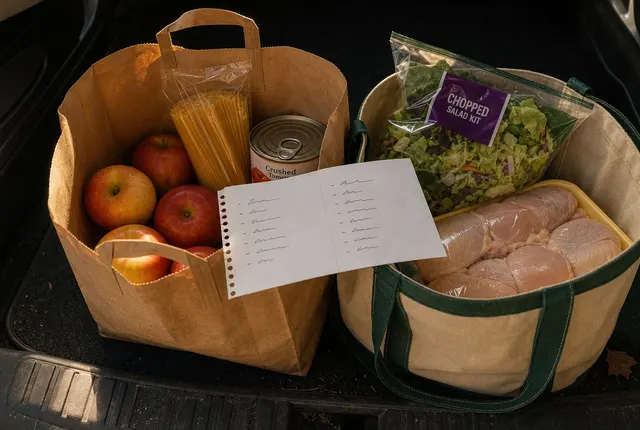 Know-how · 5 min readOne grocery store or two: how to tell when a second stop is worth itA second store can shave dollars off the list, but it costs trips, minutes and miles. Work out the saving per stop, per mile and per hour, then decide.Read the guide
 Problem guide · 6 min readIs the bulk size really cheaper? When the big bag losesThe big bag has the lower unit price, but you pay for the whole bag. Work out how much you must use for it to win, and spot sales and multi-packs that flip it.Read the guide
 Know-how · 5 min readUnit price: how to compare sizes in the store in 10 secondsRead the unit price on the shelf tag, fix mismatched units in your head, and spot when the bigger package loses. Includes a pocket card to print.Read the guide
 Practical note · 5 min readStarting a price book: what to write down for the first four weeksA price book lists what your regular groceries cost, by unit price. Here's what to record each week so that after a month you know a good price on sight.Read the guide
 Problem-solving guide · 6 min readGrocery bill keeps creeping up: a weekly routine that worksWhy grocery totals drift up week after week, and a short weekly routine to catch it: plan dinners, shop the pantry, buy from one list, log the receipt.Read the guide
Keep planning
Related tools
- GroceryPrice per unit calculatorCompare grocery prices by the ounce, pound, fluid ounce or item, including multi-packs and 2-for deals, then print a price book page.Open the tool
- GroceryMonthly grocery trackerLog each grocery receipt, keep non-food items apart, and see what's left per day and per week. Weekly checkpoints and a printable receipt log.Open the tool
- GroceryGrocery budget calculatorWork out a weekly and monthly grocery budget for your household from the USDA Food Plans cost tables, then print a monthly spending tracker.Open the tool
- GroceryPantry-first grocery listList what the week's dinners need, enter what's already on the shelf, and get a store list of only the gap, rounded up to whole packages.Open the tool
- ScaleCost per serving calculatorPrice each ingredient from the package it comes in, add the lines and divide by the servings. Rice by the cup from a 5 lb bag works too. Print the cost card.Open the tool
Checked and dated
Sources
- NIST Handbook 44, 2026 edition, Appendix C: General Tables of Units of Measurement, National Institute of Standards and Technology. Checked October 10, 2026.
See every source on the site on the sources page. Spotted an error? Tell us.