System · Shopping and budget
The monthly grocery budget, checked once a week
Quick answer
Get a monthly figure for your household from the USDA Food Plans. Split it into four weekly checkpoints plus the last days of the month, write down each grocery receipt the day you shop, compare the running total once a week, and review the month at the end. At August 2026 prices, a family of four on the moderate-cost plan comes to $1,388.20 a month: $320.50 for each of four weeks and $106.20 for day 29 to the end of the month.
Source: USDA Food Plans, cost of food at three levels, August 2026, checked October 8, 2026.
- $320.50a week for a family of four on USDA's moderate-cost plan, August 2026 prices
- $106.20left for day 29 to month end once four weeks are counted
- 4.333weeks in USDA's month: divide any monthly figure by it to get a weekly one
- +20% to -10%USDA's household-size step, from one person living alone to seven or more
Source: USDA Food Plans, cost of food at three levels, August 2026, checked October 8, 2026.
Part 1
The decision first
Do it yourself
Use the system
You want a number to hold your receipts against, and you shop for groceries at least once a week. A few minutes a week keeps the month from catching you off guard.
Skip it
Keep it lighter
If your grocery spending already sits steady and the bank statement never surprises you, skip the weekly checks and keep only the receipt log.
Get help
Get help instead
Debt, unpaid bills or a budget that can't cover food this month need a person: a nonprofit financial counselor, or a food pantry near you. This system does arithmetic only. It isn't financial advice.
Part 2
The steps, in order
Pick a starting figure
Enter your household in the grocery budget calculator and choose a level: low-cost, moderate-cost or liberal. It adds up USDA's cost for each person and applies the household-size step. Write the figure on the tracker and note which month's table it came from.
Have readyEveryone's ageLast month's receipts or bank statement
Source: USDA Food Plans, cost of food at three levels, August 2026, checked October 8, 2026.
Split the month into checkpoints
Weeks 1 to 4 each get the weekly figure, and whatever is left of the monthly figure covers day 29 to the end of the month. A family of four on the moderate-cost plan gets $320.50 a week and $106.20 for the last days. If you set your own monthly number, divide it by 4.333 for the weekly one.
Have readyThe tracker's budget column
Source: USDA Food Plans, cost of food at three levels, August 2026, checked October 8, 2026.
Log each receipt the day you shop
Write the date, the store and the total. Then take out anything that isn't food, such as soap, paper towels or pet food, since the USDA figures cover food eaten at home. Restaurant meals and takeout stay off this sheet too.
Have readyThe receiptA pen kept with the tracker
Source: USDA Food Plans, cost of food at three levels, August 2026, checked October 8, 2026.
Check the running total once a week
On the same day each week, put the budget so far next to the money spent so far. One week over doesn't matter if the next one comes in under. When you're over two weeks running, plan next week's dinners first with the weekly dinner plan and shop from that list.
Have readyThe weekly check rows
Review the month on the last day
Add up the food column and compare it with the figure. Circle anything unusual, like a stock-up trip, guests or a holiday meal, so it doesn't hide the regular weeks.
Have readyThe month-end boxYour calendar
Set next month's figure
Keep the USDA figure as a reference line and write your own monthly total beside it. After three months your own average shows what the household really spends. USDA re-prices the plans every month, so redo the calculator figure now and then.
Have readyLast month's tracker
Source: USDA Food Plans, cost of food at three levels, August 2026, checked October 8, 2026.
Figure
Source: USDA Food Plans, cost of food at three levels, August 2026, checked October 8, 2026.
The tools in this system
Let the tools do the arithmetic
- GroceryGrocery budget calculatorWork out a weekly and monthly grocery budget for your household from the USDA Food Plans cost tables, then print a monthly spending tracker.Open the tool
- GroceryMonthly grocery trackerLog each grocery receipt, keep non-food items apart, and see what's left per day and per week. Weekly checkpoints and a printable receipt log.Open the tool
- PlanWeekly dinner plan generatorPlan seven dinners as cook, leftover, assemble and flex nights, rotate four dish types, and print the week with a grocery list by store section.Open the tool
- GroceryPrice per unit calculatorCompare grocery prices by the ounce, pound, fluid ounce or item, including multi-packs and 2-for deals, then print a price book page.Open the tool
Part 3
What goes wrong
What happens when you skip a step, and how to catch it.
The whole receipt goes on the tracker
Soap, paper towels and pet food push the total up, and food spending looks worse than it is. Take non-food items off before you write the number down.
Only a monthly number
Without weekly checkpoints, you learn you're over on the last day, when there's nothing left to change. Four checkpoints give you four chances to adjust.
Four weeks treated as a month
Four weeks cover 28 days. The last two or three days of a month still need groceries, so the weekly figure times four falls short of the monthly one.
A stock-up month counts as a failure
One big warehouse trip makes a month look high and the next one look low. Mark the stock-up on the tracker and compare months over a quarter instead.
The USDA figure becomes a target
USDA prices a set basket of food cooked at home. Your cart holds different things, so your total will differ. Use it as a starting line to compare against.
Part 4
Variants that change the steps
One person
USDA adds 20% for a single-person household. A woman aged 19 to 50 on the low-cost plan comes to $330.84 a month, or $76.32 a week.
Source: USDA Food Plans, cost of food at three levels, August 2026, checked October 8, 2026.
Couple, 51 to 70
A man and a woman aged 51 to 70 on the liberal plan come to $932.80 a month after the 10% step for two people. That's $215.27 a week, with $71.72 left for the end of the month.
Source: USDA Food Plans, cost of food at three levels, August 2026, checked October 8, 2026.
Paid every two weeks
Set the tracker by paycheck instead of by calendar month: two weekly figures per paycheck, with the leftover days going to whichever paycheck covers the end of the month.
Five or more at home
USDA takes 5% off the total for five or six people and 10% off for seven or more. Add everyone up first, then apply the step once.
Source: USDA Food Plans, cost of food at three levels, August 2026, checked October 8, 2026.
Figure
From the kitchen table
Tips and tricks
Keep the tracker on the fridge with a pen clipped to it. Writing a receipt down the day you shop is quicker than sorting a week of them later.
Round each receipt to whole dollars. The cents don't change what the month tells you.
Circle stock-up trips, guest meals and holiday shopping so they stand out from the regular weeks.
Write the USDA month next to your figure, for example "August 2026 table", so you know when it's worth redoing.
If one store takes most of the money, check unit prices on the five things you buy most there with the price per unit calculator.
Recommendation
What we would do
Start with the moderate-cost figure for your household and track one full month without changing how you shop. Then pick one change from the grocery bill guide for month two, and compare the two months side by side.
Part 6 · Free, one page, US Letter
Print the working copy
Monthly grocery budget: working copy
- The figure
- Receipts
- Weekly check
- Month-end review
Planned for the store: the full Monthly Grocery Budget Kit, a binder of monthly tracker with receipt rows and weekly checkpoints, figure worksheet: household, level, size step, weekly split, year at a glance: twelve monthly totals beside the usda figure, stock-up and holiday log, paycheck version: two-week tracker.
Part 5
The primary source
Official USDA Food Plans: Cost of Food at Home at Three Levels, U.S. Average, August 2026
USDA Food and Nutrition Administration, Center for Nutrition Policy and Promotion, published September 1, 2026. Checked October 8, 2026.
USDA's Food Plans give a monthly and weekly cost of food at home for each age and sex group at three spending levels, with a household-size step and a factor of 4.333 weeks a month. On October 8, 2026, the August 2026 table was the newest one published.
Asked often
Questions
How do I set a monthly grocery budget?
Start from a published figure, not a guess. The USDA Food Plans give a monthly cost for each person by age at three spending levels; add your household up, apply the size step, and compare it with a month of your own receipts. The grocery budget calculator does the adding.
Source: USDA Food Plans, cost of food at three levels, August 2026, checked October 8, 2026.
How do I turn a monthly grocery budget into a weekly one?
Divide it by 4.333, the factor USDA uses between weekly and monthly costs. A $600 month is $138.47 a week. Four weeks of that leave $46.12 for the last days of the month.
Source: USDA Food Plans, cost of food at three levels, August 2026, checked October 8, 2026.
What counts as groceries on the tracker?
Food and drinks you buy to eat at home. Leave off household goods that share the receipt, and leave off restaurant meals, takeout and bought lunches, because the USDA figures assume all meals and snacks are made at home.
Source: USDA Food Plans, cost of food at three levels, August 2026, checked October 8, 2026.
What if I go over budget in one week?
Look at the running total, not the single week. If next week comes in under by the same amount, the month is fine. If you're over two weeks in a row, plan the next week's dinners before you shop.
Why does the end of the month get its own line?
Four weeks are 28 days, and most months are longer. The leftover money for day 29 onward keeps those last days from landing on top of week 4.
How often do the USDA figures change?
USDA publishes new Food Plans costs every month. This page uses the August 2026 table, the newest one available on October 8, 2026, and the calculator names the month it uses.
Source: USDA Food Plans, cost of food at three levels, August 2026, checked October 8, 2026.
Read next
Guides in this system
 Problem-solving guide · 6 min readGrocery bill keeps creeping up: a weekly routine that worksWhy grocery totals drift up week after week, and a short weekly routine to catch it: plan dinners, shop the pantry, buy from one list, log the receipt.Read the guide
 Know-how · 5 min readUnit price: how to compare sizes in the store in 10 secondsRead the unit price on the shelf tag, fix mismatched units in your head, and spot when the bigger package loses. Includes a pocket card to print.Read the guide
 Problem guide · 6 min readIs the bulk size really cheaper? When the big bag losesThe big bag has the lower unit price, but you pay for the whole bag. Work out how much you must use for it to win, and spot sales and multi-packs that flip it.Read the guide
 Problem-solving guide · 6 min readOver the grocery budget by the 15th: what the pace line says and how to plan the rest of the monthHalfway through the month and already past the pace line? Find out whether it was one big trip or every trip, then work out a weekly figure for the days left.Read the guide
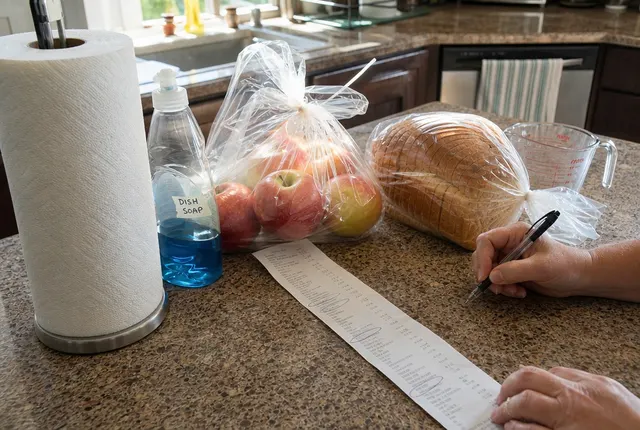 Know-how · 5 min readDo paper towels count as groceries? How to keep non-food items apart on the receiptPaper towels, soap and trash bags ride on the grocery receipt but aren't food. How to split them off in a minute and why it changes the month's numbers.Read the guide
Checked and dated
Sources
- Official USDA Food Plans: Cost of Food at Home at Three Levels, U.S. Average, August 2026, USDA Food and Nutrition Administration, Center for Nutrition Policy and Promotion. Checked October 8, 2026.
Planning and arithmetic only, not nutrition, dietary, food-safety or financial advice. See every source on the sources page. Spotted an error? Tell us.