Scale · Tool and printable
Portion scaler with cups to grams and pan sizes
Quick answer
Multiply every amount by servings wanted ÷ servings in the recipe; for a new pan, use new pan area ÷ old pan area. A US cup is 8 fluid ounces (about 237 mL), and its weight depends on the ingredient: USDA lists 125 g for a cup of all-purpose flour and 200 g for a cup of granulated sugar. Going from a 9 x 13 pan to an 8 x 8 pan is 64 ÷ 117 = 0.547, so a little over half.
Source: NIST Handbook 44 (2026), Appendix C, checked October 10, 2026; USDA FoodData Central, SR Legacy portion weights, checked October 10, 2026.
Try it
Filled in with the worked example below. Change any number and the result updates.
Multiply every amount by 1.5
6 servings wanted ÷ 4 the recipe makes = 1.5.
| Ingredient | Recipe | Scaled | Measure as | Weight |
|---|---|---|---|---|
| All-purpose flour | 2 cup | 3 cup | 3 cups | 375 g |
| Butter | 0.5 cup | 0.75 cup | 3/4 cup | 170 g |
| Granulated sugar | 3 tbsp | 4.5 tbsp | 1/4 cup + 1 1/2 tsp | 56 g |
| Eggs | 2 each | 3 each | 3 | no figure |
Step by step, no jargon
How to use this, in plain words
- 1
Find the serving count on your recipe. It usually sits near the title, as "Serves" or "Makes" with a number.
- 2
Type in the servings you want, then copy each ingredient line with its amount and unit.
- 3
Read the scaled amounts. The tool turns them into cup and spoon sizes you can measure, with grams beside them.
- 4
If the recipe names a pan, enter its size. The tool shows which pan holds the new amount.
- 5
Print the scaled recipe card and keep it next to the original while you cook.
Before you start
- Write the scaled amounts down before you start. Doing the math at the counter is where mistakes slip in.
- Things that come whole, like eggs and cans, don't always split cleanly. Round to a whole one and note the change on the card.
- Grams are more exact than cups for flour and sugar. If you own a kitchen scale, use the gram column.
- This tool scales amounts only. It doesn't change cooking times or temperatures; those stay with your recipe.
The method
How it works
- By servings: factor = servings you want ÷ servings the recipe makes.
- By pan: factor = area of your pan ÷ area of the recipe's pan. A rectangle is length × width, a square is side × side and a round pan is 3.1416 × (diameter ÷ 2)².
- Scaled amount = recipe amount × factor, in the recipe's own unit.
- Kitchen measures: 1 cup = 8 fl oz = 16 tbsp, and 1 tbsp = 3 tsp. The tool breaks an awkward amount into cups, tablespoons and teaspoons to the nearest 1/8 tsp.
- Grams from cups = cups × the ingredient's grams per cup from USDA FoodData Central. Ounces to grams uses 28.35 g per ounce and 453.6 g per pound.
Source: NIST Handbook 44 (2026), Appendix C, checked October 10, 2026; USDA FoodData Central, SR Legacy portion weights, checked October 10, 2026.
Step by step
Worked example
A recipe for 4 servings uses 2 cups of all-purpose flour, 1/2 cup of butter, 3 tbsp of sugar and 2 eggs. You want 6 servings.
- Factor: 6 servings wanted ÷ 4 servings in the recipe = 1.5.
- Flour: 2 cups × 1.5 = 3 cups. At 125 g per cup that is 375 g.
- Butter: 0.5 cup × 1.5 = 0.75 cup, measured as 3/4 cup, or 170 g at 227 g per cup.
- Sugar: 3 tbsp × 1.5 = 4.5 tbsp, which is easier to measure as 1/4 cup + 1 1/2 tsp.
- Eggs: 2 × 1.5 = 3, so use 3 eggs.
Figure
Put it on the fridge
What to record
Your household
Variants
Halve or double
Set servings wanted to half or twice the recipe's servings for a factor of 0.5 or 2. Eggs are the awkward line: half of 3 eggs is 1.5, so beat 2 eggs and use about three quarters of the mix.
9 x 13 to 8 x 8
A 9 x 13 pan holds 117 sq in and an 8 x 8 pan holds 64, so the factor is 0.547. Two 8 x 8 pans hold 128 sq in, close to one 9 x 13.
Round to square
A 9 inch round pan is 3.1416 × 4.5² = 63.6 sq in, almost the same as an 8 inch square at 64 sq in, so most recipes move between them unchanged.
Metric kitchens
Switch to metric to enter pan sizes in centimeters and see mL and grams first. A US cup is 8 fluid ounces, about 237 mL.
Source: NIST Handbook 44 (2026), Appendix C, checked October 10, 2026.
Published figures
Numbers this tool uses
Limitations
- Planning estimate; check the recipe's own weights if it gives them, since a cup of flour weighs more or less depending on how you fill it.
- Gram figures are USDA's standard weights for each ingredient. Brands, sifting and packing change the weight of a cup.
- A new pan changes depth and baking time. The factor keeps the batter at the same depth, but check for doneness early. We don't give oven or cooking-safety guidance.
Checking the result
If the answer surprises you
A cup of flour looks light in grams? Flour is fluffy, so a cup weighs far less than a cup of sugar. The weights come from USDA FoodData Central.
Odd amounts such as a third of a cup plus a tablespoon are normal after scaling. The tool rounds to measures most kitchens own.
The pan answer is about floor area. A pan with the same area but different depth fills to a different height.
Asked often
Questions
How many grams are in a cup of flour?
USDA FoodData Central lists 125 g for a cup of all-purpose flour and 137 g for bread flour. How you fill the cup changes the weight, so weigh the flour if the recipe gives grams.
Source: USDA FoodData Central, SR Legacy portion weights, checked October 10, 2026.
How many tablespoons are in a cup?
16. A cup is 8 fluid ounces and a tablespoon is half a fluid ounce. A tablespoon is 3 teaspoons, so a cup is 48 teaspoons.
Source: NIST Handbook 44 (2026), Appendix C, checked October 10, 2026.
Can I use an 8 x 8 pan for a 9 x 13 recipe?
Use about 0.55 of the recipe: an 8 x 8 pan is 64 sq in and a 9 x 13 is 117 sq in. If you make the whole recipe in the smaller pan, it will be much deeper and take longer to bake.
What do I do with half an egg?
Beat the egg, then measure out roughly half by eye or by weight. For 1.5 eggs, you can also use 2 small eggs. The tool shows the exact figure and the next whole number up.
Does scaling change cooking time?
Often, yes, especially in a different pan or a much bigger pot. The tool scales amounts only. Check the recipe and test for doneness early.
Read next
Guides that go deeper
 Problem-solving guide · 5 min readRecipes for 4, dinner for 2: why you end up cooking every nightTwo people who both pack lunch eat a recipe for 4 in two meals, so the week needs a cook night almost every day. Double batches halve the count.Read the guide
 Know-how · 5 min readHalve the recipe or freeze half: the cook-night math for oneCooking for one from recipes for 4: half recipes need twice the cook nights, whole ones need freezer space. Count both for your week and pick per recipe.Read the guide
 Problem-solving guide · 6 min readDoubling a recipe for a crowd: the shopping-list sideFeeding 12 from a recipe for 4? Scale every line, total each ingredient across dishes, subtract the pantry and round up to packages once. Chart included.Read the guide
 Know-how · 5 min readWhy a cup of flour weighs less than a cup of sugarA cup measures space, not weight. See what a cup of flour, sugar, butter, honey and oats weighs in USDA data, and how to switch a recipe to grams.Read the guide
 Problem-solving guide · 6 min readHow to halve a recipe when the amounts get awkwardHalf of 1/3 cup, half of 3 eggs, half a can: turn each awkward amount into spoons you own. Includes a halving chart for the cupboard door.Read the guide
 Know-how · 5 min readPan swaps: will a 9 x 13 recipe fit two 8 x 8 pans?Yes, with room to spare. Compare pan areas to see how deep the batter sits in two 8 x 8s, two rounds or one 9 x 9, and print a pan-area card for the drawer.Read the guide
 Know-how · 5 min readUnit price: how to compare sizes in the store in 10 secondsRead the unit price on the shelf tag, fix mismatched units in your head, and spot when the bigger package loses. Includes a pocket card to print.Read the guide
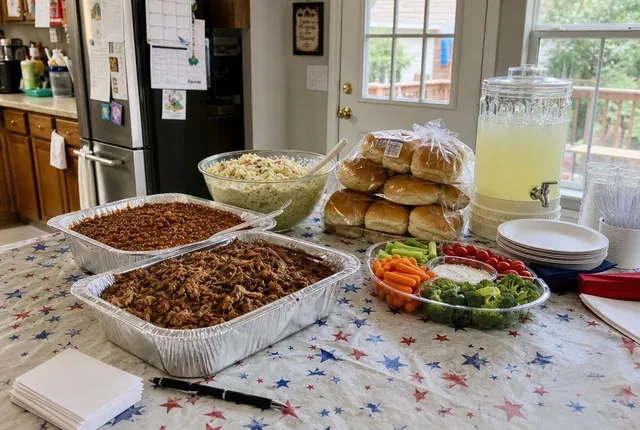 Problem-solving guide · 6 min readWe invited 80 to the open house. How many will come?A drop-in party never brings everyone you invite. See how the 60% planning rule turns 80 invitations into food for 48, and what it changes on each dish.Read the guide
The whole job
Systems that use this tool
This tool is one part of a finished routine. The system page puts it in order with the other steps.
 SystemHolidays and gatherings · 7 steps · free printableFriendsgiving and potluck sign-up: who brings what, and how muchRun a Friendsgiving or potluck from one sign-up sheet: slots in fill order, every dish sized to the headcount, turkey math and heat needs. Free printable.Open the system
 SystemHolidays and gatherings · 7 steps · free printableHalloween week dinners: fed and out the door before darkPlan Halloween week so dinner is eaten before trick-or-treating: cook earlier in the week, make the 31st an assemble night, shop once. Free printable.Open the system
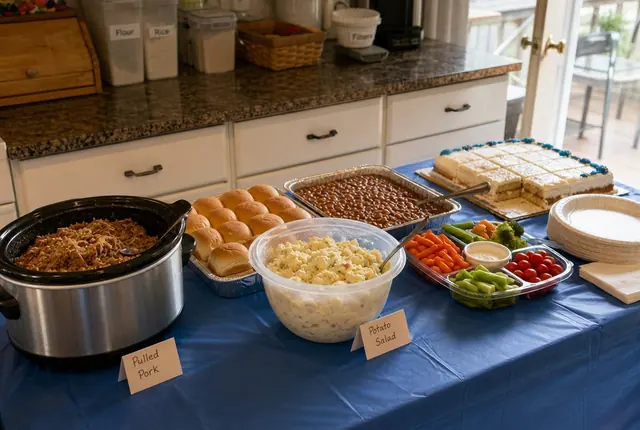 SystemHolidays and gatherings · 7 steps · free printableParty food quantities: how much to make per guest, and the list it turns intoHow much food for a party: plan 1 to 1½ pounds per guest, count 60% of invites for an open house, then turn ounces per guest into a list. Free printable.Open the system
 SystemHolidays and gatherings · 8 steps · free printableThanksgiving dinner plan: from headcount to the last dishPlan Thanksgiving dinner in order: headcount, turkey size per person, who brings what, two shopping trips and an oven plan. Free printable working copy.Open the system
 SystemHolidays and gatherings · 7 steps · free printableThanksgiving week: easy nights before, leftover nights afterPlan the nine nights around Thanksgiving: light dinners while the oven and fridge are busy, then leftover nights you count from the turkey. Free printable.Open the system
Keep planning
Related tools
- OccasionsParty food quantity calculatorType your guest count and menu. Get pounds, pieces and gallons for each dish from Iowa State Extension's per-guest table, plus a printable quantity sheet.Open the tool
- OccasionsHoliday dinner timeline plannerList each dish with its oven setting and minutes. Get a dated countdown for the days before and a timeline for the day, counted back from serving time.Open the tool
- PlanMeal plan for oneMost recipes serve 4. Plan a week for one adult that cooks only when leftovers run out, sends the rest to lunches and the freezer, and prints a sheet.Open the tool
- PlanMeal plan for twoA recipe for 4 is only two meals for two. Plan a week of dinners for two and lunches for one or both, cook double or whole, and print the week sheet.Open the tool
- ScalePan size converterSwap a recipe's pan for the ones you own. Compare floor area, batter depth and how full each pan gets, split one batch across pans, and print a pan card.Open the tool
- ScaleCups to grams converterTurn a recipe's cups and spoons into grams, or grams back into cups, for 53 ingredients from USDA data. Weigh it all into one bowl and print a weights card.Open the tool
- ScaleCost per serving calculatorPrice each ingredient from the package it comes in, add the lines and divide by the servings. Rice by the cup from a 5 lb bag works too. Print the cost card.Open the tool
- PlanWeekly dinner plan generatorPlan seven dinners as cook, leftover, assemble and flex nights, rotate four dish types, and print the week with a grocery list by store section.Open the tool
- GroceryGrocery budget calculatorWork out a weekly and monthly grocery budget for your household from the USDA Food Plans cost tables, then print a monthly spending tracker.Open the tool
- GroceryPrice per unit calculatorCompare grocery prices by the ounce, pound, fluid ounce or item, including multi-packs and 2-for deals, then print a price book page.Open the tool
- ScaleBatch cooking and freezer portion plannerList what you're cooking on batch day and see how many servings you'll make, what to eat fresh, how many freezer dinners and containers you need, and labels.Open the tool
- ScaleOven temperature converterConvert oven settings between °F and °C, rounded to your dial, then line up every dish's recipe time on one oven: when to preheat, change and put each in.Open the tool
Checked and dated
Sources
- NIST Handbook 44, 2026 edition, Appendix C: General Tables of Units of Measurement, National Institute of Standards and Technology. Checked October 10, 2026.
- FoodData Central: SR Legacy food portion data (April 2018 release), USDA Agricultural Research Service, FoodData Central. Checked October 10, 2026.
See every source on the site on the sources page. Spotted an error? Tell us.