Grocery · Tool and printable
Monthly grocery tracker
Quick answer
Add up the food part of every receipt so far, then compare it with your budget × today's day ÷ the days in the month. That's the straight-line pace. In the worked example, $381.95 is spent by October 15 against a pace of $314.52, so the month is $67.43 ahead of pace. The $268.05 left works out to $16.75 a day, or $117.27 a week, for the last 16 days.
Source: no outside figures. This tool works only from what you enter.
Try it
Filled in with the worked example below. Change any number and the result updates.
October 2026, day 15 of 31 $268.05 left, about $16.75 a day
Food spent$381.95 of $650.00 (59% of the money, 48% of the month): $67.43 ahead of the straight-line pace of $314.52.
spent $381.95 pace for day 15 $314.52 month $650.00
- Left for the rest of the month
- $268.05
- 16 days left: a week's share
- $117.27
- Month end if spending keeps this rate
- $789.36
- Trips so far
- 5, about $76.39 each
- Non-food on the receipts, kept apart
- $39.95
Receipt log
| Day | Store | Total | Non-food | Food | Running | Left |
|---|---|---|---|---|---|---|
| Oct 2 | Supermarket | $142.60 | $18.40 | $124.20 | $124.20 | $525.80 |
| Oct 5 | Corner market | $23.75 | - | $23.75 | $147.95 | $502.05 |
| Oct 9 | Supermarket | $131.10 | $12.35 | $118.75 | $266.70 | $383.30 |
| Oct 12 | Farmers market | $28.00 | - | $28.00 | $294.70 | $355.30 |
| Oct 14 | Supermarket | $96.45 | $9.20 | $87.25 | $381.95 | $268.05 |
Weekly checkpoints
| Checkpoint | Budget so far | Spent so far | Over or under |
|---|---|---|---|
| Day 7 | $146.77 | $147.95 | $1.18 over |
| Day 14 | $293.55 | $381.95 | $88.40 over |
| Day 21 | $440.32 | ||
| Day 28 | $587.10 | ||
| Month end, day 31 | $650.00 |
Budget so far = $650.00 × checkpoint day ÷ 31. Blank rows are still ahead: fill them in on the printed copy.
By store
- Supermarket$330.20 · 3 trips · 86%
- Farmers market$28.00 · 1 trip · 7%
- Corner market$23.75 · 1 trip · 6%
Step by step, no jargon
How to use this, in plain words
- 1
Type your monthly grocery budget. No figure yet? Get one from the grocery budget calculator first, then round it to a number you'll remember.
- 2
Pick the month, and type the day you're checking. The "Use today's date" button fills both in.
- 3
Copy each receipt: the day, the store and the total at the bottom, tax included. Keep the receipts in one envelope or snap a photo at the register.
- 4
Circle the things on the receipt you don't eat, like trash bags, dish soap or a birthday card, and add them up. That's the non-food part.
- 5
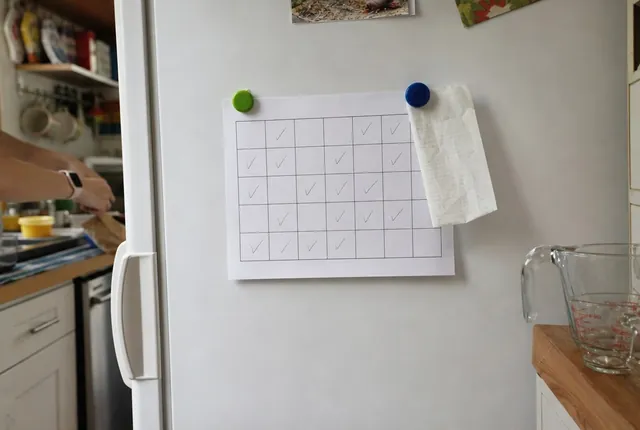
Read the pace line and what's left per week, then print the tracker and stick it on the fridge. Fill in each checkpoint as you reach it.
Before you start
- Decide now whether paper towels and soap come out of the grocery money. Either choice works, as long as you stick with it for the whole month.
- Log a receipt the day you shop. Five receipts in a pile at month end take far longer to sort out than one a day.
- Count every store, including the gas-station milk run and the farmers market. Small trips add up, and they're the easiest to forget.
- If you split a big trip with someone, log only your share so the running total stays honest.
The method
How it works
- Food on a receipt = receipt total − the non-food part (trash bags, soap, a card). Pick "count them in" and the whole total counts.
- Spent so far = the food amounts added up, oldest receipt first. Left = budget − spent so far.
- Pace on day d = budget × d ÷ days in the month. Spent so far − pace = how far ahead of or behind pace you are.
- Per day for the rest of the month = left ÷ days left. A week's share = left × 7 ÷ days left.
- Month end at this rate = spent so far ÷ d × days in the month. It's a straight line, so one big stock-up trip early in the month pushes it up.
- Weekly checkpoints fall on days 7, 14, 21 and 28 and the last day of the month. Each one compares budget × checkpoint day ÷ days in the month with what was spent by then.
Step by step
Worked example
Two adults set a $650 October grocery budget, rounded down from the USDA low-cost figure for two adults aged 19 to 50 ($652.19 a month at August 2026 prices). On October 15 they have five receipts: the supermarket on the 2nd ($142.60, with $18.40 of paper towels and dish soap), the corner market on the 5th ($23.75), the supermarket on the 9th ($131.10, $12.35 non-food), the farmers market on the 12th ($28.00) and the supermarket on the 14th ($96.45, $9.20 non-food). Non-food stays out of the food budget.
- Take the non-food part off each receipt: $142.60 − $18.40 = $124.20; $131.10 − $12.35 = $118.75; $96.45 − $9.20 = $87.25. The receipts with no non-food items count in full.
- Add the food amounts: $124.20 + $23.75 + $118.75 + $28.00 + $87.25 = $381.95 by day 15.
- Straight-line pace: $650.00 × 15 ÷ 31 days = $314.52. $381.95 − $314.52 = $67.43 ahead of pace.
- Left: $650.00 − $381.95 = $268.05 for 16 days, so $268.05 ÷ 16 = $16.75 a day, or $117.27 a week.
- If spending kept the first 15 days' rate, the month would end at $381.95 ÷ 15 × 31 = $789.36. The early stock-up trip pushes that number up, so watch the day 21 and day 28 checkpoints instead.
Figure
Put it on the fridge
What to record
Your household
Variants
Non-food counted in
Pick "count them in" if one budget covers the whole store trip. The non-food lines still show in the totals, so you can see how much of the budget they take.
Paid every two weeks
Use the day 14 checkpoint as your payday check. Whatever is left at day 14 is what the second paycheck's half of the month has to cover.
One big shop a month
Log the big trip on its day and the top-up trips after it. Your total will run far ahead of the diagonal from day one, so read only "left" and the per-week figure. Ignore the pace line until the last week.
Two stores, one budget
Type the store on each receipt. The By store list shows each store's share, so you can see where most of the money goes.
Published figures
Numbers this tool uses
| Figure | Value | Source, date checked |
|---|---|---|
| USDA low-cost plan, two adults aged 19 to 50 | $652.19 a month at August 2026 prices (household-size step +10%) | USDA Food Plans, cost of food at three levels, August 2026, October 8, 2026 |
| Same household, moderate-cost plan | $807.62 a month | USDA Food Plans, cost of food at three levels, August 2026, October 8, 2026 |
| How USDA turns weekly costs into monthly ones | Weekly cost × 4.333 | USDA Food Plans, cost of food at three levels, August 2026, October 8, 2026 |
Limitations
- Planning estimate; check it against your bank or card statement at month end, since a lost receipt is easy to miss.
- The pace line assumes even spending across the month. Real shopping comes in trips, so being a little over or under between trips is normal.
- Numbers only, not advice. The tool tracks the budget you give it and doesn't say what a household should spend.
Checking the result
If the answer surprises you
Over pace early in the month? If you do one big shop first, the running total jumps ahead of the diagonal and then flattens. Watch the day 21 and day 28 checkpoints before you change anything.
The month-end projection looks scary? It assumes every day costs what the first days cost. After a stock-up trip it runs high, and it settles down as the month goes on.
The checkpoints differ from the grocery budget calculator's tracker by a few dollars? That page splits the USDA weekly figure into four full weeks plus the days left over. This page splits your own monthly figure evenly across every day of the month.
Asked often
Questions
How do I know if I'm on track with my grocery budget?
Multiply your monthly budget by today's day of the month, divide by the number of days in the month, and compare that with what you've spent. If you've spent more, you're ahead of pace. The tool does this and also shows what's left per day for the rest of the month.
Should paper towels and cleaning supplies count in the grocery budget?
That's up to you, but pick one way and keep it for the whole month. The USDA Food Plans price food only, so if your budget came from those tables, keeping non-food items out makes the comparison fair.
Source: USDA Food Plans, cost of food at three levels, August 2026, checked October 8, 2026.
What if I'm already over budget halfway through the month?
The tool shows how much over you are and sets the money left per day to zero. Look at the By store list and the receipt log to see which trips pushed it over, then use the price book and pantry-first list for the rest of the month.
How often should I check the tracker?
Log each receipt the day you shop, and look at the pace once a week on the checkpoint days: 7, 14, 21 and 28. Checking every day mostly shows the ups and downs of single trips.
Do the receipts I type get saved or sent anywhere?
No. The math runs in your browser, and nothing you type leaves the page. Print the tracker or write the numbers on the printed sheet to keep them.
Read next
Guides that go deeper
 Know-how · 5 min readBulk at the register vs per month: why the cart costs more and the month costs lessA bulk cart rings up more today and less over the next few months. Read the register total and the monthly cost of what you use, and see when each one counts.Read the guide
 Problem-solving guide · 6 min readOver the grocery budget by the 15th: what the pace line says and how to plan the rest of the monthHalfway through the month and already past the pace line? Find out whether it was one big trip or every trip, then work out a weekly figure for the days left.Read the guide
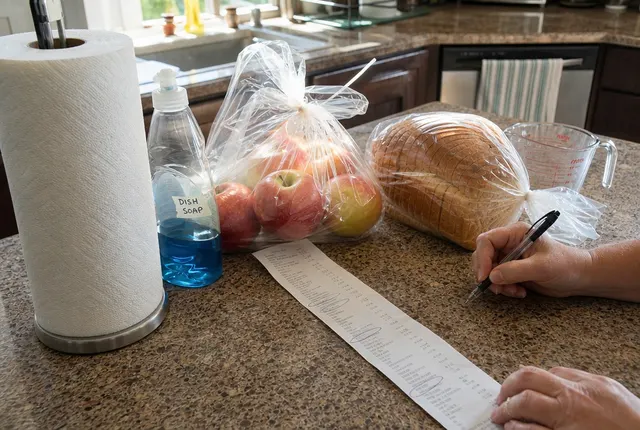 Know-how · 5 min readDo paper towels count as groceries? How to keep non-food items apart on the receiptPaper towels, soap and trash bags ride on the grocery receipt but aren't food. How to split them off in a minute and why it changes the month's numbers.Read the guide
 Problem-solving guide · 6 min readGrocery bill keeps creeping up: a weekly routine that worksWhy grocery totals drift up week after week, and a short weekly routine to catch it: plan dinners, shop the pantry, buy from one list, log the receipt.Read the guide
 Know-how · 6 min readWhat the USDA Food Plans are, in plain wordsWhat the USDA low-cost, moderate-cost and liberal food plans measure, how to read the table for your household, and what the figures leave out.Read the guide
 Practical note · 5 min readStarting a price book: what to write down for the first four weeksA price book lists what your regular groceries cost, by unit price. Here's what to record each week so that after a month you know a good price on sight.Read the guide
 Know-how · 5 min readUnit price: how to compare sizes in the store in 10 secondsRead the unit price on the shelf tag, fix mismatched units in your head, and spot when the bigger package loses. Includes a pocket card to print.Read the guide
 Know-how · 5 min readWhy the receipt and the cost per serving never matchA pot of chili costs $20.90 by the serving but $38.61 at the register. The gap is the part of each package the pot didn't use. Here's how to read both numbers.Read the guide
The whole job
Systems that use this tool
This tool is one part of a finished routine. The system page puts it in order with the other steps.
Keep planning
Related tools
- GroceryStore comparison worksheetPrice your monthly staples at up to three stores and see the cheapest store, the cheapest way to split the list, and whether a club fee pays off.Open the tool
- GroceryGrocery budget calculatorWork out a weekly and monthly grocery budget for your household from the USDA Food Plans cost tables, then print a monthly spending tracker.Open the tool
- GroceryPrice per unit calculatorCompare grocery prices by the ounce, pound, fluid ounce or item, including multi-packs and 2-for deals, then print a price book page.Open the tool
- GroceryPantry-first grocery listList what the week's dinners need, enter what's already on the shelf, and get a store list of only the gap, rounded up to whole packages.Open the tool
- PlanWeekly dinner plan generatorPlan seven dinners as cook, leftover, assemble and flex nights, rotate four dish types, and print the week with a grocery list by store section.Open the tool
- ScaleCost per serving calculatorPrice each ingredient from the package it comes in, add the lines and divide by the servings. Rice by the cup from a 5 lb bag works too. Print the cost card.Open the tool
Checked and dated
Sources
- Official USDA Food Plans: Cost of Food at Home at Three Levels, U.S. Average, August 2026, USDA Food and Nutrition Administration, Center for Nutrition Policy and Promotion. Checked October 8, 2026.
See every source on the site on the sources page. Spotted an error? Tell us.