System · Shopping and budget
The grocery price book: know a good price before you reach the shelf
Quick answer
List the 20 groceries that show up on most of your receipts. Give each one a single unit, the one shelf tags use for it: per pound or ounce for food sold by weight, per fluid ounce or quart for liquids, per item for counts. For four weeks, write the store, date, size, price and unit price every time you see the item. Then circle the lowest unit price for each item. That's your buy price. When a tag matches or beats it, stock up to the level your pantry holds. When it doesn't, buy only what this week needs.
Source: NIST Handbook 130 (2026), Uniform Unit Pricing Regulation, checked October 10, 2026.
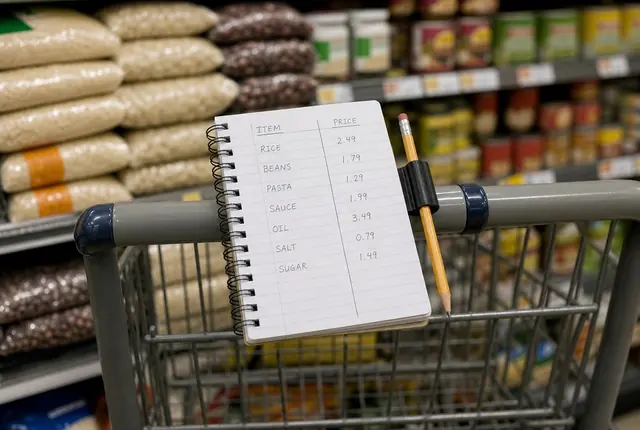
- 20 itemsto start with, from your last few receipts; add more once the habit sticks
- 4 weeksof rows before you circle a buy price for each item
- 50¢or less: under the model rule, a package this cheap (or under 1 oz) doesn't need a unit price on the tag
- 1/10 of a centthe finest a unit price under a dollar has to show; a store may round to the whole cent instead
Source: NIST Handbook 130 (2026), Uniform Unit Pricing Regulation, checked October 10, 2026.
Part 1
The decision first
Do it yourself
Keep a price book
You buy roughly the same groceries most weeks, you shop at more than one store or watch the sales, and you have room in the pantry to buy ahead when the price is right.
Skip it
Skip it for now
You shop at one store, buy the same few things whatever they cost, and have no space to stock up. Compare the unit prices on the shelf tags each trip, and leave it at that.
Get help
Get help instead
Debt, unpaid bills or a budget that can't cover food this month need a person: a nonprofit financial counselor, or a food pantry near you. This system does arithmetic only. It isn't financial advice.
Part 2
The steps, in order
Pick your top 20 from receipts
Circle every item that appears on more than one receipt. Keep the 20 you spend the most on or buy the most often: rice, coffee, eggs, milk, bread, canned tomatoes, cheese, chicken. Fresh produce can wait until the habit sticks.
Have readyYour last two or three grocery receiptsA pen
Give each item one unit
Use the unit the shelf tags already use. Under the model unit pricing rule in NIST Handbook 130, food sold by weight is priced per pound or ounce, liquids per gallon, quart, pint or fluid ounce, and counted items per item. Pick one for each line and stick to it. Per pound keeps the cents readable: $0.081 an ounce is $1.30 a pound.
Have readyThe list from step 1A shelf tag or two to look at
Source: NIST Handbook 130 (2026), Uniform Unit Pricing Regulation, checked October 10, 2026; NIST Handbook 44 (2026), Appendix C, checked October 10, 2026.
Set up the page
One block of rows per item. The columns are store, date, size, price, unit price and sale or regular, with the item and its unit written at the top of the block. A spreadsheet works the same way and does the division for you.
Have readyThe free price book page belowOr a notebook ruled into seven columns
Write a row every trip for four weeks
Copy the tag or the receipt line for each item on your list, at every store you go to, sale or not. If a tag uses a different unit from your book, or a store skips the unit price, work it out with the price per unit calculator. A photo of the shelf tag, copied at home, is fine.
Have readyThe page on a clipboard, or your phone camera
Circle the buy price
For each item, find the lowest unit price you wrote down and copy it to the top of the block. In the rice example, the four rows read $1.50, $1.30, $1.25 and $1.40 a pound, so the buy price is $1.25, from a 2 for $5 sale on 2 lb bags.
Have readyFour weeks of rowsA highlighter
Check the tag against the buy price
At the shelf, read the unit price and compare it with the circled number. A 5 lb bag at $6.49 is $1.30 a pound, above $1.25, so buy only what the week needs. When a tag matches or beats it, buy enough to bring the item up to its full level on the pantry inventory, and no further.
Have readyThe pageYour pantry inventory with full levels
Keep it current in five minutes a week
After the first month, add a row only when a price is new or lower. If a buy price hasn't come back in two months, cross it out and circle the lowest price from those two months. Once a month, carry your buy prices into the grocery budget calculator check, so the budget uses what your items really cost.
Have readyThe pageThis week's receipt
Figure
The tools in this system
Let the tools do the arithmetic
- GroceryPrice per unit calculatorCompare grocery prices by the ounce, pound, fluid ounce or item, including multi-packs and 2-for deals, then print a price book page.Open the tool
- FreezerPantry inventory and restock listCount the pantry shelf by shelf, set a restock point and a full level for each staple, and print the inventory with a restock list sorted by zone.Open the tool
- GroceryPantry-first grocery listList what the week's dinners need, enter what's already on the shelf, and get a store list of only the gap, rounded up to whole packages.Open the tool
- GroceryGrocery budget calculatorWork out a weekly and monthly grocery budget for your household from the USDA Food Plans cost tables, then print a monthly spending tracker.Open the tool
Part 3
What goes wrong
What happens when you skip a step, and how to catch it.
Writing the sticker price
A shelf price without a size can't be compared with anything. If package sizes change or two sizes sit side by side, only the unit price column tells you which one costs less.
Two units for one item
One row in ounces and the next in pounds makes the lowest number look like the best price when it isn't. Convert before you write: 16 ounces to the pound.
Source: NIST Handbook 44 (2026), Appendix C, checked October 10, 2026.
Whole-cent tags hiding a gap
A store may round unit prices under a dollar to the whole cent, so $0.081 and $0.084 an ounce both print as $0.08. Per pound, that's $1.30 against $1.34. Work it out yourself when two tags look the same.
Source: NIST Handbook 130 (2026), Uniform Unit Pricing Regulation, checked October 10, 2026.
A buy price from a one-off clearance
A markdown on dented cans or a closing-out item may never come back. If it hasn't returned in two months, replace it, or you'll pass up good prices waiting for it.
Stocking up past what you'll use
A low price only saves money on the part you eat. Buy to the pantry's full level and stop there. Is bulk really cheaper shows how to check a big package against the share you'll actually use.
Too many items
A long list is hard to keep up. Start with 20 and add a line only when something new keeps turning up on your receipts.
Part 4
Variants that change the steps
One store only
It works with one store too: it tracks sizes and sale weeks at one store, so you can see whether the sale price is really lower than last month's regular price. Leave the store column blank.
Two or three stores
Add a store letter to every row. After a month, the circled prices may come from different stores. Write the store next to each buy price so you know where to buy each item.
Spreadsheet or phone notes
Same seven columns, one row per sighting. Sort by item, then by unit price, and the top row of each item is its buy price. Keep a printed copy of the buy prices in your wallet or phone for the shelf.
Holiday baking list
If you bake for the holidays, add flour, sugar, butter, chocolate chips and nuts now, so a November sale tag has a month of your own prices to be measured against.
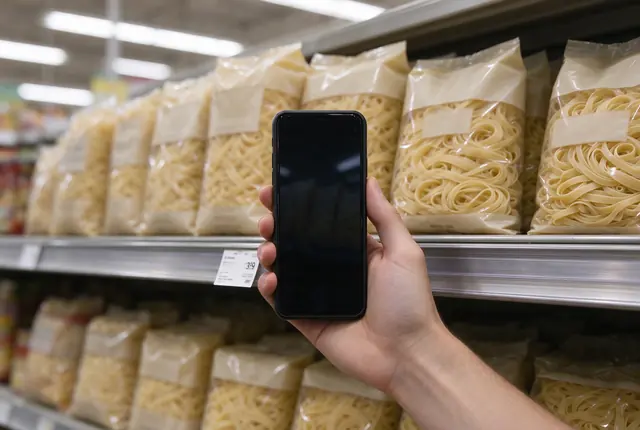
Figure
Source: NIST Handbook 130 (2026), Uniform Unit Pricing Regulation, checked October 10, 2026; NIST Handbook 44 (2026), Appendix C, checked October 10, 2026.
From the kitchen table
Tips and tricks
Write the unit next to the item name at the top of its block, so nobody adds a row in the wrong unit later.
Keep the store brand and the name brand on separate lines. If you'd buy either one, put them on the same line and let the unit price decide.
A tag that shows a unit price for a multi-pack or a 2 for $5 deal may be for one package. Check it against the deal price, or divide it yourself.
Snap a photo of any tag you can't stop to copy. Copy them into the book at the kitchen table on Sunday.
Put the buy price on your pantry inventory sheet as well, next to the full level, so the restock list and the price check sit on one page.
Recommendation
What we would do
Start with the 12 items that show up on every receipt, not 20, and write rows for four weeks without trying to save anything yet. Circle the buy prices, then use them for one month: stock up only on matches, and only to the pantry's full level. Add the next eight items after that.
Part 6 · Free, one page, US Letter
Print the working copy
Price book page
- Item __________ Unit ______ Buy price $______
- Item __________ Unit ______ Buy price $______
- Buy prices (after week 4)
- At the shelf
Planned for the store: the full Price Book Kit, a binder of top 20 list with one unit per item, item blocks: four weeks of rows per item, buy price at the top, buy price card for the wallet, with store and full level, monthly update log: new lows, retired buy prices, one-store page with sale weeks marked, holiday baking price list.
Part 5
The primary source
NIST Handbook 130, 2026 edition, IV.C Uniform Unit Pricing Regulation
National Institute of Standards and Technology / National Conference on Weights and Measures, published January 1, 2026. Checked October 10, 2026.
The Uniform Unit Pricing Regulation in NIST Handbook 130 (2026 edition) is the model rule behind US shelf tags: which unit a tag uses for foods sold by weight, volume or count, how unit prices are rounded, which packages are exempt, and what a shared sign must show. It applies where a state or city adopts it and only when a store chooses to show unit prices. This system uses it to pick each item's unit and to read the tags. We read the 2026 edition on October 10, 2026.
Asked often
Questions
What is a grocery price book?
A record of what your regular groceries cost at the stores you use, written as unit prices. After a few weeks it shows the lowest price you see for each item, so you can tell a real low price from an ordinary sale tag.
Which unit should I use for each item?
The one shelf tags use for it. The model unit pricing rule prices food sold by weight per pound or ounce, liquids per gallon, quart, pint or fluid ounce, and counted items per item. Pick one per item and write every row in it.
Source: NIST Handbook 130 (2026), Uniform Unit Pricing Regulation, checked October 10, 2026.
Why doesn't every shelf tag show a unit price?
Some states and cities require unit prices; elsewhere the store decides. Under the model rule, even a store that shows them can leave off packages under 1 oz, items priced 50 cents or less, and an item sold in only one brand and one size.
Source: NIST Handbook 130 (2026), Uniform Unit Pricing Regulation, checked October 10, 2026.
How long before a price book is useful?
About four weeks. That gives you several rows per item at the stores you use, enough to see what a low price looks like. Keep adding rows after that, but only when a price is new or lower.
Is the lowest unit price always the one to buy?
Only if you'll use what you buy. A bigger package or a stock-up saves money on the part you eat before it goes stale or gets thrown out. Buy to the level your pantry holds and stop there.
Read next
Guides in this system
 Practical note · 5 min readStarting a price book: what to write down for the first four weeksA price book lists what your regular groceries cost, by unit price. Here's what to record each week so that after a month you know a good price on sight.Read the guide
 Know-how · 5 min readUnit price: how to compare sizes in the store in 10 secondsRead the unit price on the shelf tag, fix mismatched units in your head, and spot when the bigger package loses. Includes a pocket card to print.Read the guide
 Problem guide · 6 min readIs the bulk size really cheaper? When the big bag losesThe big bag has the lower unit price, but you pay for the whole bag. Work out how much you must use for it to win, and spot sales and multi-packs that flip it.Read the guide
 Problem-solving guide · 6 min readGrocery bill keeps creeping up: a weekly routine that worksWhy grocery totals drift up week after week, and a short weekly routine to catch it: plan dinners, shop the pantry, buy from one list, log the receipt.Read the guide
Checked and dated
Sources
- NIST Handbook 130, 2026 edition, IV.C Uniform Unit Pricing Regulation, National Institute of Standards and Technology / National Conference on Weights and Measures. Checked October 10, 2026.
- NIST Handbook 44, 2026 edition, Appendix C: General Tables of Units of Measurement, National Institute of Standards and Technology. Checked October 10, 2026.
Planning and arithmetic only, not nutrition, dietary, food-safety or financial advice. See every source on the sources page. Spotted an error? Tell us.