Scale · Tool and printable
Oven temperature converter: both scales, and one oven for every dish
Quick answer
°F = °C × 1.8 + 32, and °C = (°F − 32) ÷ 1.8. Then round to your dial. 180 °C is 356 °F, so set 350 °F. 200 °C is 392 °F, so 400 °F. 220 °C is 428 °F, so 425 °F. Going the other way, 350 °F is 176.7 °C (set 180 °C) and 375 °F is 190.6 °C (set 190 °C).
Source: NIST Guide to the SI (SP 811), Appendix B.9, checked October 11, 2026.
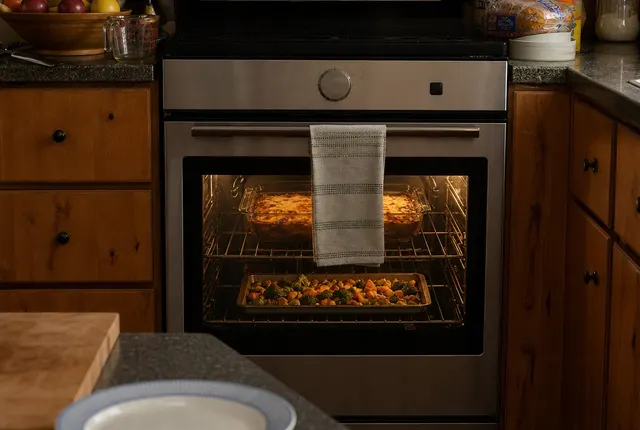
Try it
Filled in with the worked example below. Change any number and the result updates.
Oven plan 3 settings, one oven. Turn it on at 3:55 pm; it's done at 7:00 pm (3 h 5 min).
Each dish in both scales
| Dish | Recipe says | Exact | Set the dial | In | Out |
|---|---|---|---|---|---|
| Lasagna | 375 °F | 190.6 °C | 375 °F (190 °C) | 4:10 pm | 5:10 pm 35 min early |
| Roast vegetables | 220 °C | 428 °F | 425 °F (220 °C) | 5:25 pm | 6:00 pm |
| Garlic bread | 425 °F | 218.3 °C | 425 °F (220 °C) | 5:50 pm | 6:00 pm |
| Apple crumble | 180 °C | 356 °F | 350 °F (180 °C) | 6:20 pm | 7:00 pm |
The oven, hour by hour
- Lasagna 375 °F4:10 pm to 5:10 pm
- Roast vegetables 425 °F5:25 pm to 6:00 pm
- Garlic bread 425 °F5:50 pm to 6:00 pm
- Apple crumble 350 °F6:20 pm to 7:00 pm
- 3:55 pmTurn the oven on to 375 °F (190 °C)
- 4:10 pm Lasagna goes in
- 5:10 pm Lasagna comes out
- 5:10 pmChange the oven to 425 °F (220 °C)
- 5:25 pm Roast vegetables goes in
- 5:50 pm Garlic bread goes in
- 6:00 pm Roast vegetables comes out
- 6:00 pm Garlic bread comes out
- 6:05 pmChange the oven to 350 °F (180 °C)
- 6:20 pm Apple crumble goes in
- 7:00 pm Apple crumble comes out
- 7:00 pmOven off
One dish moves earlier because the oven is busy at another setting: Lasagna comes out at 5:10 pm, 35 min before you planned. To keep it closer to dinner, change a ready time or move a dish to another appliance. For how long cooked food can wait, see FoodSafety.gov.
Your oven card
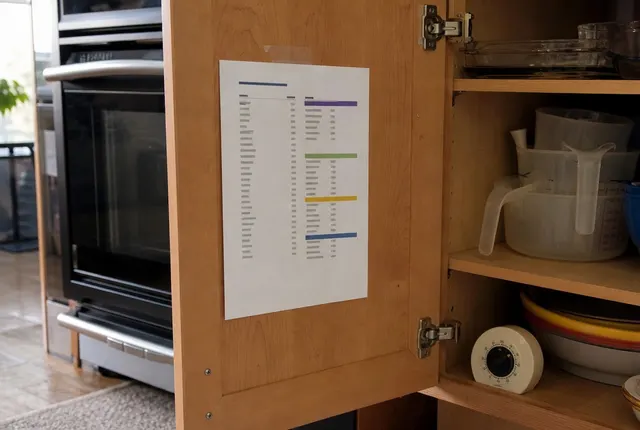
Both directions, rounded to the dial. Tape it inside a cupboard door near the oven.
| Fahrenheit | °C exact | Set °C |
|---|---|---|
| 250 °F | 121.1 | 120 °C |
| 275 °F | 135 | 140 °C |
| 300 °F | 148.9 | 150 °C |
| 325 °F | 162.8 | 160 °C |
| 350 °F | 176.7 | 180 °C |
| 375 °F | 190.6 | 190 °C |
| 400 °F | 204.4 | 200 °C |
| 425 °F | 218.3 | 220 °C |
| 450 °F | 232.2 | 230 °C |
| 475 °F | 246.1 | 250 °C |
| 500 °F | 260 | 260 °C |
| Celsius | °F exact | Set °F |
|---|---|---|
| 120 °C | 248 | 250 °F |
| 130 °C | 266 | 275 °F |
| 140 °C | 284 | 275 °F |
| 150 °C | 302 | 300 °F |
| 160 °C | 320 | 325 °F |
| 170 °C | 338 | 350 °F |
| 180 °C | 356 | 350 °F |
| 190 °C | 374 | 375 °F |
| 200 °C | 392 | 400 °F |
| 210 °C | 410 | 400 °F |
| 220 °C | 428 | 425 °F |
| 230 °C | 446 | 450 °F |
| 240 °C | 464 | 475 °F |
| 250 °C | 482 | 475 °F |
| 260 °C | 500 | 500 °F |
The tool converts settings and lines up your recipe's own times. It doesn't give cooking times or tell you when food is done; follow your recipe for that.
Step by step, no jargon
How to use this, in plain words
- 1
Copy the oven setting from each recipe, with its scale. A recipe from Britain or Europe usually means °C. "Fan" or "gas mark" means it was written for a fan or gas oven.
- 2
Copy the minutes in the oven, and any wait before serving, like letting a lasagna sit. Give dessert its own ready time.
- 3
Time your own oven once: turn it on and note how long it takes to beep. Put that in the preheat box.
- 4
Read the dial setting for each dish, then the hour-by-hour list: when to turn the oven on, when to change it, when each dish goes in and comes out.
- 5
Print the plan with the oven card and tape it near the stove for the day.
Before you start
- Most US oven dials and keypads work in Fahrenheit. Round the converted number to a setting your oven actually offers; the tool shows the exact figure beside it.
- Gas marks and fan settings aren't converted here. We couldn't find a government or extension table for them, so look up your recipe's original oven or your oven manual.
- For convection, go by your oven manual. Some ovens lower the setting for you when you pick convection, so subtracting again would double it.
- Your dial can be off. An oven thermometer on the middle rack shows what the oven really reaches.
The method
How it works
- Celsius from Fahrenheit: subtract 32, then divide by 1.8. Fahrenheit from Celsius: multiply by 1.8, then add 32.
- Round the converted number to the steps your dial uses: the nearest 25 °F or 5 °F, the nearest 10 °C or 5 °C. The setting in the recipe's own scale stays exactly as written.
- Out time = ready time − the wait your recipe asks for. In time = out time − the recipe's minutes in the oven.
- One oven holds one setting at a time. Dishes at the same °F setting share it. Two dishes at different settings need a gap between them as long as your oven takes to heat or change, so the dish that comes out last keeps its time and an earlier one moves earlier.
- Convection: if your oven manual says to lower the setting by a number of degrees, enter it and the tool subtracts it from each dial setting. With nothing entered, nothing changes.
Source: NIST Guide to the SI (SP 811), Appendix B.9, checked October 11, 2026.
Step by step
Worked example
Sunday dinner at 6:00 pm from four recipes, two of them British: a lasagna at 375 °F for 60 minutes that sits 15 minutes before serving, roast vegetables at 220 °C for 35 minutes, garlic bread at 425 °F for 10 minutes, and an apple crumble at 180 °C for 40 minutes for dessert at 7:00 pm. The oven takes 15 minutes to heat or change setting, and the dial goes in 25 °F steps.
- Roast vegetables, 220 °C: 220 × 1.8 + 32 = 428 °F, so set 425 °F. Apple crumble, 180 °C: 180 × 1.8 + 32 = 356 °F, so 350 °F. Lasagna, 375 °F: (375 − 32) ÷ 1.8 = 190.6 °C, about 190 °C.
- The crumble comes out last (7:00 pm), so it keeps its time: in at 6:20 pm. The vegetables and garlic bread share 425 °F and both come out at 6:00 pm; the bread goes in for its last 10 minutes at 5:50 pm.
- The lasagna wants 5:45 pm out (15 minutes before dinner), but the oven has to be at 425 °F by 5:25 pm and needs 15 minutes to get there. So it comes out at 5:10 pm, 35 minutes early, and goes in at 4:10 pm.
- Turn the oven on at 3:55 pm (15 minutes before the lasagna). It changes setting twice and goes off at 7:00 pm: 3 h 5 min in all.
Figure
Put it on the fridge
What to record
Your household
Variants
Just convert one setting
Enter one dish with any time and read the dial column. The oven card underneath lists 250 to 500 °F and 120 to 260 °C both ways, so most days you won't need the tool at all.
A holiday with one oven
Enter every dish that needs the oven and the time dinner goes on the table. The tool shows which dishes can share a setting and which have to go in earlier. Set a separate ready time for anything served later, like pie.
Convection from your manual
If your oven manual says to lower the setting for convection, type that number in. Each dish gets a convection column in °F and °C. Leave it empty if your oven adjusts on its own.
Digital ovens in 5 degree steps
Pick 5 °F or 5 °C rounding. 220 °C then shows 430 °F instead of 425 °F, and 350 °F shows 175 °C.
Published figures
Numbers this tool uses
| Figure | Value | Source, date checked |
|---|---|---|
| °F to °C | t/°C = (t/°F − 32) ÷ 1.8 | NIST Guide to the SI (SP 811), Appendix B.9, October 11, 2026 |
| °C to °F | t/°F = t/°C × 1.8 + 32 | NIST Guide to the SI (SP 811), Appendix B.9, October 11, 2026 |
Limitations
- Planning estimate; check your recipe for the setting and time, and your oven's own preheat time. The converted numbers are exact arithmetic; the dial setting is rounded.
- The tool converts settings and lines up times you enter. It doesn't give cooking times, tell you when food is done, or give safe temperatures; follow your recipe for those.
- No gas mark or fan conversions, and no convection rule: we found no government or extension table for them. For how long cooked food can wait before serving, see FoodSafety.gov.
Checking the result
If the answer surprises you
180 °C converts to 356 °F, not 350. Recipes round, and so does the tool: 350 °F is the closest 25 °F step. Pick 5 °F steps to see 355 °F.
A dish came out earlier than you planned? Another dish needed the oven at a different setting just then. The one that comes out last keeps its time; earlier dishes can only move earlier.
Two dishes at 400 °F and 425 °F still count as different settings. Use the one each recipe gives; the tool won't pick a middle setting for you.
Asked often
Questions
What is 180 °C in Fahrenheit for an oven?
180 × 1.8 + 32 = 356 °F. Set 350 °F on a dial that goes in 25 degree steps, or 355 °F on a keypad that takes 5 degree steps.
Source: NIST Guide to the SI (SP 811), Appendix B.9, checked October 11, 2026.
What is 200 °C or 220 °C in Fahrenheit?
200 °C is 392 °F, so set 400 °F. 220 °C is 428 °F, so set 425 °F.
Source: NIST Guide to the SI (SP 811), Appendix B.9, checked October 11, 2026.
What is 350 °F in Celsius?
(350 − 32) ÷ 1.8 = 176.7 °C. On a Celsius dial that goes in 10s, set 180 °C.
Source: NIST Guide to the SI (SP 811), Appendix B.9, checked October 11, 2026.
How do I cook two dishes at different temperatures in one oven?
One after the other, with time to change the setting in between. Enter both with their times and the tool shows which goes first, when to change the oven and when each comes out. Dishes at the same setting can go in together.
Do I lower the temperature for a convection oven?
Check your oven manual. Some ovens lower the setting for you when you pick convection. If the manual gives a number to lower it by, type it in and the tool shows the convection setting for each dish.
Does the tool tell me how long to cook something?
No. It uses the times from your recipes and only puts them in order on one oven. For doneness, follow the recipe.
Read next
Guides that go deeper
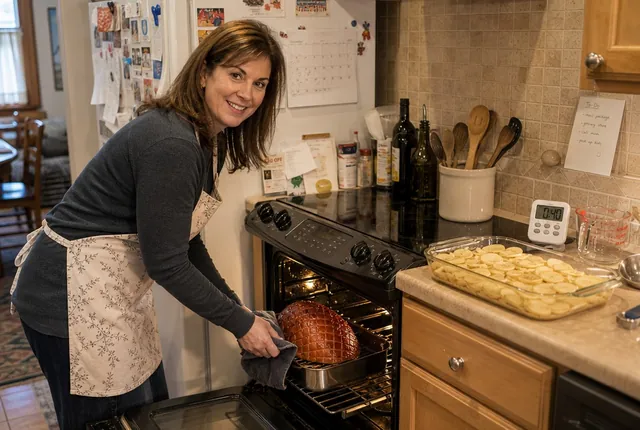 Problem-solving guide · 6 min readThe ham comes out at 2:15 for a 4:00 dinner: fixing a one-oven clashYour timeline pulls the main dish out hours early because a side needs another oven setting. See four fixes and how much each one changes the timing.Read the guide
 Know-how · 5 min readWhy recipes say 350 °F and 180 °C when they aren't equal350 °F is 176.7 °C and 180 °C is 356 °F. Recipes round each to a number the dial shows. The exact math, the rounding steps, and a card of common pairs.Read the guide
 Problem-solving guide · 6 min readOne oven, five dishes: plan the holiday oven backward from dinnerTwo dishes at different settings can't both come out at dinner time. Work backward from the table, group by setting, and see which dish moves and why.Read the guide
 Know-how · 5 min readTwo casseroles, one oven: ordering a freezer prep dayTwo casseroles at different oven settings make one of them wait. When that wait costs time on a freezer prep day, and the order that hides it.Read the guide
Keep planning
Related tools
- OccasionsHoliday dinner timeline plannerList each dish with its oven setting and minutes. Get a dated countdown for the days before and a timeline for the day, counted back from serving time.Open the tool
- ScalePan size converterSwap a recipe's pan for the ones you own. Compare floor area, batter depth and how full each pan gets, split one batch across pans, and print a pan card.Open the tool
- ScalePortion scaler with unit conversionScale a recipe up or down by servings or by pan size, see each amount in cups, tablespoons and grams, and print the scaled recipe card.Open the tool
- ScaleBatch cooking and freezer portion plannerList what you're cooking on batch day and see how many servings you'll make, what to eat fresh, how many freezer dinners and containers you need, and labels.Open the tool
- PlanWeekly dinner plan generatorPlan seven dinners as cook, leftover, assemble and flex nights, rotate four dish types, and print the week with a grocery list by store section.Open the tool
Checked and dated
Sources
- NIST Guide to the SI, Appendix B.9: Factors for units listed by kind of quantity or field of science (Temperature), National Institute of Standards and Technology. Checked October 11, 2026.
See every source on the site on the sources page. Spotted an error? Tell us.