Scale · Tool and printable
Cups to grams converter by ingredient
Quick answer
There is no single cups-to-grams number, because a cup measures space. Multiply the cups by the USDA weight of 1 cup of that ingredient: 125 g for all-purpose flour, 200 g for granulated sugar, 220 g for packed brown sugar, 227 g for butter. So 1½ cups of flour is 188 g. To go back, divide the grams by the same figure.
Source: USDA FoodData Central, SR Legacy portion weights, checked October 10, 2026.
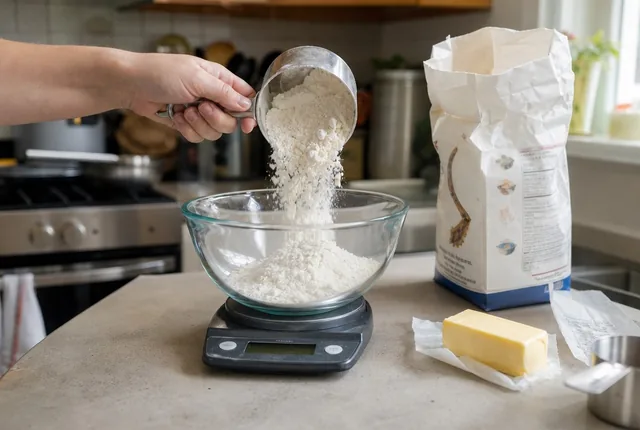
Try it
Filled in with the worked example below. Change any number and the result updates.
Weigh it into one bowl 952 g in all (33.6 oz) across 7 lines.
- Cups and spoons turned into grams
- 6
- Grams turned into cups
- 1
- Ingredients on your card
- 11
Line by line, in the order you add them
| Ingredient | You have | Weigh out / measure as | Ounces / cups | Scale reads (bowl total) |
|---|---|---|---|---|
| All-purpose flour 125 g per cup | 1.5 cup | 188 g | 6.61 oz | 188 g |
| Rolled oats 81 g per cup | 2 cup | 162 g | 5.71 oz | 350 g |
| Brown sugar, packed 220 g per cup | 0.75 cup | 165 g | 5.82 oz | 515 g |
| Butter 227 g per cup | 0.5 cup | 114 g | 4 oz | 629 g |
| Baking soda 4.6 g per tsp | 1 tsp | 4.6 g | 0.16 oz | 634 g |
| Chocolate chips 168 g per cup | 1 cup | 168 g | 5.93 oz | 802 g |
| Whole wheat flour 120 g per cup | 150 g | 1 1/4 cups | 1.25 cup | 952 g |
Set the empty bowl on the scale and press tare. Add each line until the scale shows the bowl total, without pressing tare again in between.
Your kitchen weights card, grams
Tape it inside a cupboard door. Each row is one ingredient, from a full cup down to a teaspoon.
| Ingredient | 1 cup | 3/4 cup | 2/3 cup | 1/2 cup | 1/3 cup | 1/4 cup | 1 tbsp | 1 tsp |
|---|---|---|---|---|---|---|---|---|
| All-purpose flour | 125 | 94 | 83 | 63 | 42 | 31 | 7.8 | 2.6 |
| Rolled oats | 81 | 61 | 54 | 41 | 27 | 20 | 5.1 | 1.7 |
| Brown sugar, packed | 220 | 165 | 147 | 110 | 73 | 55 | 14 | 4.6 |
| Butter | 227 | 170 | 151 | 114 | 76 | 57 | 14 | 4.7 |
| Baking soda | by the spoon | by the spoon | by the spoon | by the spoon | by the spoon | by the spoon | 14 | 4.6 |
| Chocolate chips | 168 | 126 | 112 | 84 | 56 | 42 | 11 | 3.5 |
| Whole wheat flour | 120 | 90 | 80 | 60 | 40 | 30 | 7.5 | 2.5 |
| Granulated sugar | 200 | 150 | 133 | 100 | 67 | 50 | 13 | 4.2 |
| White rice, uncooked | 185 | 139 | 123 | 93 | 62 | 46 | 12 | 3.9 |
| Table salt | 292 | 219 | 195 | 146 | 97 | 73 | 18 | 6.1 |
| Baking powder | by the spoon | by the spoon | by the spoon | by the spoon | by the spoon | by the spoon | 14 | 4.6 |
Step by step, no jargon
How to use this, in plain words
- 1
Copy each line off the recipe as it is written: the number, the unit (cup, tbsp, tsp, or g, oz, lb) and the ingredient.
- 2
Pick the closest ingredient in the list. Check the small words on the recipe: "packed" brown sugar, "shredded" cheese and "chopped" nuts each have their own weight.
- 3
Read the grams to weigh out. Lines given in grams or ounces come back as cups and spoons you can measure.
- 4
To weigh everything into one bowl, set the empty bowl on the scale and press tare once. Add each ingredient until the scale shows that line's bowl total.
- 5
Add up to four ingredients you use often and print the weights card. It fits inside a cupboard door.
Before you start
- A kitchen scale that reads in 1 g steps is enough for everything here. Spoon amounts under 5 g are easier to measure with the spoon.
- If the recipe says "sifted flour", the cup holds less flour than an unsifted scoop. To check, fill a cup the way the recipe says and weigh it.
- Butter wrappers show tablespoon marks. A full stick is ½ cup, which USDA puts at 113 g.
- Check whether the recipe means the ingredient dry or cooked. Every grain, bean and pasta figure here is for the dry, uncooked food.
The method
How it works
- A US cup is 8 fluid ounces, a tablespoon is half a fluid ounce, and a teaspoon is a third of a tablespoon, so 1 cup holds 16 tablespoons or 48 teaspoons.
- Look up the weight of 1 cup of the ingredient in USDA FoodData Central. A few small-measure staples, like baking soda and vanilla, are listed by the teaspoon instead.
- Grams = the amount in cups × the weight of 1 cup. For tablespoons, divide by 16 first; for teaspoons, by 48.
- Cups = grams ÷ the weight of 1 cup. The tool turns ounces and pounds into grams first: an ounce is 28.35 g and a pound is 453.59 g.
- Weighing into one bowl: the scale reading after each line is the running total of everything added so far.
Source: NIST Handbook 44 (2026), Appendix C, checked October 10, 2026; USDA FoodData Central, SR Legacy portion weights, checked October 10, 2026.
Step by step
Worked example
An oat bar ingredient list written in cups, to be weighed into one bowl on a kitchen scale, plus one line from a recipe written in grams: 150 g of whole wheat flour.
- Grams = cups × the USDA weight of 1 cup of that ingredient. All-purpose flour: 1.5 cup × 125 g = 188 g.
- The same step for the rest of the cup lines: rolled oats 2 cup × 81 = 162 g; brown sugar, packed 0.75 cup × 220 = 165 g; butter 0.5 cup × 227 = 114 g; chocolate chips 1 cup × 168 = 168 g.
- Baking soda is listed by the teaspoon (4.6 g per tsp), so 1 tsp = 4.6 g. A small amount like this is easier to measure with the spoon.
- Going the other way, cups = grams ÷ the weight of 1 cup. Whole wheat flour: 150 g ÷ 120 g = 1.25 cups, which you measure as 1 1/4 cups.
- Weighed into one bowl, the scale reads 188 g, then 350 g, then 515 g, then 629 g, then 634 g, then 802 g, then 952 g. The whole bowl comes to 952 g, about 33.6 oz.
Figure
Put it on the fridge
What to record
The kitchen weights card lists your ingredients in grams for each cup and spoon size, so the scale replaces the measuring cups for the things you make most. The card above fills in from your list; the printable sheet is a blank one. Each row has:
- Ingredient
- 1 cup
- 3/4 cup
- 2/3 cup
- 1/2 cup
- 1/3 cup
- 1/4 cup
- 1 tbsp
- 1 tsp
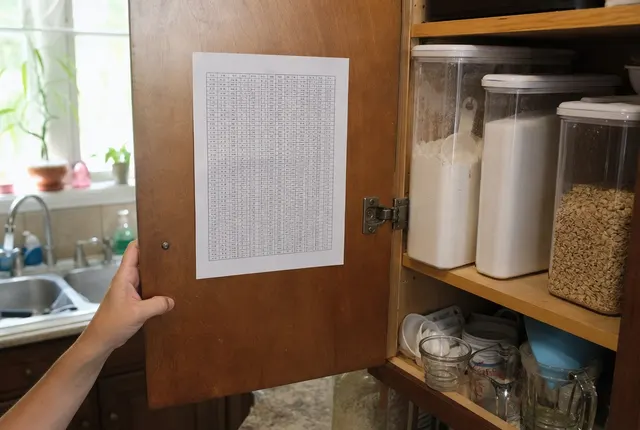
Your household
Variants
Grams to cups, for recipes written by weight
Type the grams and pick the ingredient. 150 g of whole wheat flour at 120 g a cup is 1¼ cups. Ounces work the same way: 8 oz of granulated sugar is 227 g, about 1 cup plus 2 tablespoons.
Source: USDA FoodData Central, SR Legacy portion weights, checked October 10, 2026; NIST Handbook 44 (2026), Appendix C, checked October 10, 2026.
Weigh into one bowl
Tare the empty bowl once, then add each line until the scale shows its bowl total. The oat bar list reads 188 g, 350 g, 515 g and so on up to 952 g, and there are no measuring cups to wash afterwards.
Spoon-sized amounts
USDA lists baking soda, baking powder, cinnamon and vanilla by the teaspoon. One teaspoon of baking soda is 4.6 g, so the card shows only the spoon columns for these.
Source: USDA FoodData Central, SR Legacy portion weights, checked October 10, 2026.
Scaling as well as converting
To make more or fewer servings, scale the recipe first with the portion scaler, then convert the new amounts here. The order doesn't change the grams.
Published figures
Numbers this tool uses
| Figure | Value | Source, date checked |
|---|---|---|
| 1 measuring cup | 8 US fluid ounces = 16 tablespoons = 48 teaspoons | NIST Handbook 44 (2026), Appendix C, October 10, 2026 |
| 1 ounce (weight) | 28.349523125 g; 1 pound = 453.59237 g | NIST Handbook 44 (2026), Appendix C, October 10, 2026 |
| All-purpose flour, 1 cup | 125 g | USDA FoodData Central, SR Legacy portion weights, October 10, 2026 |
| Brown sugar, 1 cup packed / not packed | 220 g / 145 g | USDA FoodData Central, SR Legacy portion weights, October 10, 2026 |
| Butter, 1 stick / 1 cup | 113 g / 227 g | USDA FoodData Central, SR Legacy portion weights, October 10, 2026 |
| Dry pasta, 1 cup elbows / small shells | 122 g / 64 g | USDA FoodData Central, SR Legacy portion weights, October 10, 2026 |
| Baking soda, 1 teaspoon | 4.6 g | USDA FoodData Central, SR Legacy portion weights, October 10, 2026 |
Limitations
- Planning estimate; check your own scale and the recipe's notes. Cup weights are USDA averages for one product of each kind, and how firmly a cup is filled changes the weight.
- Grams are rounded the way a kitchen scale shows them: whole grams from 10 g up, one decimal below that.
- Numbers only. The tool converts measures and doesn't give cooking, storage or food-safety instructions; for those, see USDA FoodKeeper.
Checking the result
If the answer surprises you
Different from the number on a bag or another website? Cup weights depend on how the cup was filled. These are USDA averages, and a chart that assumes a lighter scoop of flour will give fewer grams per cup.
Brown sugar way off? Packed brown sugar is 220 g a cup and loose brown sugar is 145 g. Most US recipes mean packed.
Pasta has no single cup weight. Elbows weigh 122 g a cup and small shells 64 g, because shells leave more air in the cup. Weigh pasta instead of measuring it.
Asked often
Questions
How many grams are in a cup?
It depends on the ingredient, because a cup measures volume. In USDA data a cup of water is 237 g, all-purpose flour 125 g, granulated sugar 200 g, butter 227 g and honey 339 g.
Source: USDA FoodData Central, SR Legacy portion weights, checked October 10, 2026.
How many grams is 1 cup of all-purpose flour?
125 g in USDA FoodData Central. Half a cup is about 63 g and a quarter cup about 31 g. Flour packed down into the cup can weigh noticeably more.
Source: USDA FoodData Central, SR Legacy portion weights, checked October 10, 2026.
How do I convert grams back to cups?
Divide the grams by the weight of 1 cup of that ingredient. 300 g of granulated sugar at 200 g a cup is 1½ cups.
Source: USDA FoodData Central, SR Legacy portion weights, checked October 10, 2026.
Is a stick of butter half a cup?
Yes. USDA lists 1 stick at 113 g and 1 cup at 227 g, so a stick is half a cup, or 8 tablespoons.
Source: USDA FoodData Central, SR Legacy portion weights, checked October 10, 2026; NIST Handbook 44 (2026), Appendix C, checked October 10, 2026.
Why do other charts give different grams for the same cup?
Each chart assumes a way of filling the cup. Dipping the cup into the bag packs in more flour than spooning it in and leveling it. Pick one chart and stick with it; this tool uses USDA figures throughout.
Read next
Guides that go deeper
 Practical note · 5 min readWeigh, don't scoop: bake from one bowl on a kitchen scalePut one bowl on the scale, tare once, and weigh each ingredient in by its running total. A worked oat bar list, a fix for overshooting, and a printable card.Read the guide
 Know-how · 5 min readPacked or loose? The recipe words that change a cup's weightPacked, sifted, chopped, shredded: each word changes what a cup weighs. USDA pairs for brown sugar, powdered sugar, nuts, raisins and cheese, in grams.Read the guide
 Know-how · 5 min readWhy a cup of flour weighs less than a cup of sugarA cup measures space, not weight. See what a cup of flour, sugar, butter, honey and oats weighs in USDA data, and how to switch a recipe to grams.Read the guide
 Problem-solving guide · 6 min readHow to halve a recipe when the amounts get awkwardHalf of 1/3 cup, half of 3 eggs, half a can: turn each awkward amount into spoons you own. Includes a halving chart for the cupboard door.Read the guide
 Problem-solving guide · 6 min readDoubling a recipe for a crowd: the shopping-list sideFeeding 12 from a recipe for 4? Scale every line, total each ingredient across dishes, subtract the pantry and round up to packages once. Chart included.Read the guide
Keep planning
Related tools
- ScalePortion scaler with unit conversionScale a recipe up or down by servings or by pan size, see each amount in cups, tablespoons and grams, and print the scaled recipe card.Open the tool
- ScalePan size converterSwap a recipe's pan for the ones you own. Compare floor area, batter depth and how full each pan gets, split one batch across pans, and print a pan card.Open the tool
- ScaleCost per serving calculatorPrice each ingredient from the package it comes in, add the lines and divide by the servings. Rice by the cup from a 5 lb bag works too. Print the cost card.Open the tool
- ScaleBatch cooking and freezer portion plannerList what you're cooking on batch day and see how many servings you'll make, what to eat fresh, how many freezer dinners and containers you need, and labels.Open the tool
- GroceryPrice per unit calculatorCompare grocery prices by the ounce, pound, fluid ounce or item, including multi-packs and 2-for deals, then print a price book page.Open the tool
Checked and dated
Sources
- FoodData Central: SR Legacy food portion data (April 2018 release), USDA Agricultural Research Service, FoodData Central. Checked October 10, 2026.
- NIST Handbook 44, 2026 edition, Appendix C: General Tables of Units of Measurement, National Institute of Standards and Technology. Checked October 10, 2026.
See every source on the site on the sources page. Spotted an error? Tell us.