Scale · Tool and printable
Pan size converter: swap pans by area, depth and fill
Quick answer
Compare floor areas, not the numbers on the pans. A 9 x 13 pan has 117 square inches of floor. Two 8 x 8 pans have 128, so the full recipe fits and sits 91% as deep. One 9 x 9 has 81, so the batter sits 44% deeper; make 0.69 of the recipe (about two thirds) to keep the depth. If you know the batter in cups, depth = cups × 14.4375 ÷ floor area.
Source: NIST Handbook 44 (2026), Appendix C, checked October 10, 2026.
Try it
Filled in with the worked example below. Change any number and the result updates.
Closest to the recipe pan Two 9 in rounds: the full recipe sits 92% as deep.
- Recipe pan
- 13 in x 9 in, 117 sq in of floor
- Batter
- 8 cups, 0.99 in deep
- Recipe pan holds
- 16.2 cups (49% full)
Each pan, side by side
| Pan | The full recipe | To match the recipe | Batter per pan |
|---|---|---|---|
| Two 8 x 8 pans 128 sq in of floor | 91% as deep as the recipe pan 0.9 in deep, 45% full, 1.1 in of room above | 1.09 × the recipe (about 1) 8.75 cups of batter | 4 cups |
| 9 x 9 pan 81 sq in of floor | 144% as deep as the recipe pan 1.43 in deep, 71% full, 0.57 in of room above | 0.69 × the recipe (about 2/3) 5.54 cups of batter | 8 cups |
| Two 9 in rounds closest 127.2 sq in of floor | 92% as deep as the recipe pan 0.91 in deep, 45% full, 1.09 in of room above | 1.09 × the recipe (about 1) 8.7 cups of batter | 4 cups |
| Jelly roll pan 150 sq in of floor | 78% as deep as the recipe pan 0.77 in deep, 77% full, 0.23 in of room above | 1.28 × the recipe (about 1 1/4) 10.3 cups of batter | 8 cups |
| Bundt pan holds 12 cups | 67% full | 0.74 × the recipe (about 3/4) 5.92 cups of batter | 8 cups |
"To match" keeps the batter at the recipe's depth (pans with a size) or the pan as full (pans given by capacity). Multiply every ingredient by that number, or use the full recipe and expect the depth shown.
Your pan drawer card
One line per pan, measured once. Tape it inside the cupboard where the pans live.
| Pan | Inside size | Floor | Side height | Holds to the rim | × recipe pan |
|---|---|---|---|---|---|
| 9 x 13 (recipe) | 13 in x 9 in | 117 sq in | 2 in | 16.2 cups | 1 |
| Two 8 x 8 pans | 8 in x 8 in | 64 sq in | 2 in | 8.9 cups | 0.55 |
| 9 x 9 pan | 9 in x 9 in | 81 sq in | 2 in | 11.2 cups | 0.69 |
| Two 9 in rounds | 9 in round | 63.6 sq in | 2 in | 8.8 cups | 0.54 |
| Jelly roll pan | 15 in x 10 in | 150 sq in | 1 in | 10.4 cups | 1.28 |
| Bundt pan | by capacity | 12 cups | 0.74 | ||
Keep the oven setting your recipe gives and start checking early: thinner batter tends to finish sooner and deeper batter later. This tool doesn't give baking times or temperatures.
Step by step, no jargon
How to use this, in plain words
- 1
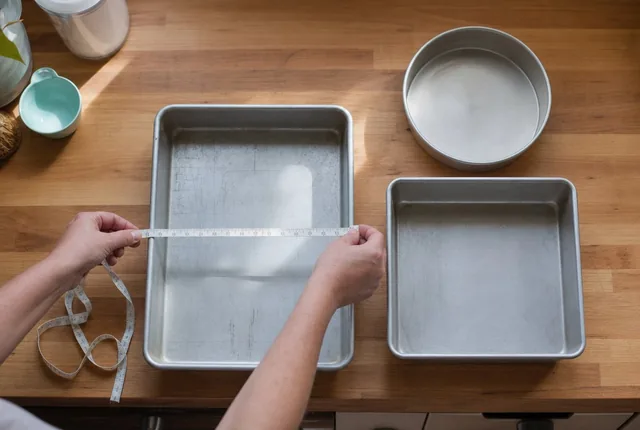
Find the size the recipe calls for. Then measure the inside of each of your pans across the top, wall to wall. If the size is stamped on the bottom, that works too.
- 2
Measure the side height: stand a ruler inside the pan and read where the rim meets it.
- 3
For a Bundt, tube or odd dish, fill it with water one cup at a time and count the cups.
- 4
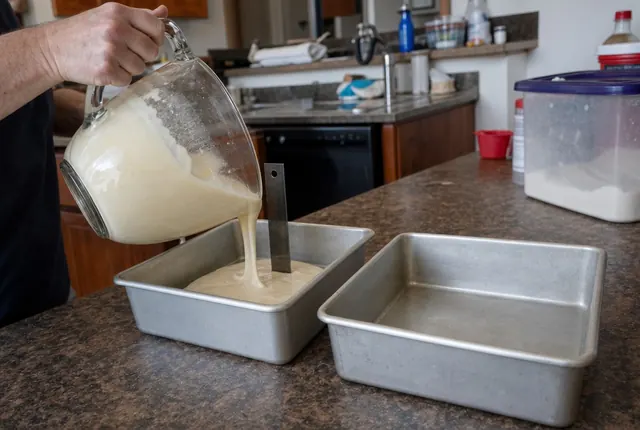
If you can, pour the batter into a big measuring jug before it goes in the pan, or note how deep it sits. With that, the tool also shows depth and how full each pan gets.
- 5
Read the closest pan, the depth it gives, and the number to multiply the recipe by if you want the same depth. Print the pan card and tape it inside the cupboard.
Before you start
- Many pans have sloped sides, so the floor is a bit smaller than the top measurement. The tool uses the top measurement, so a pan that slopes a lot runs a little deeper than shown.
- A pan sold as 9 x 13 isn't always exactly that inside. Measure your own once and use the real numbers.
- This tool matches size only. Pan material and the oven setting come from your recipe.
- Leave room at the top. The tool shows how much space is left above the batter; your recipe's own note on how full to fill a pan comes first.
The method
How it works
- Floor area: length × width for a rectangle, side × side for a square, 3.1416 × (diameter ÷ 2)² for a round. Two of the same pan count double.
- A US gallon is 231 cubic inches and a cup is a sixteenth of a gallon, so 1 cup of batter takes up 14.4375 cubic inches. An inch is 2.54 cm.
- Batter depth = batter volume ÷ floor area. Depth compared with the recipe pan = recipe pan's area ÷ new area.
- How full = batter depth ÷ side height. What a pan holds to the rim = floor area × side height ÷ 14.4375, in cups.
- To keep the recipe's depth, multiply the recipe by new area ÷ old area. For a pan given only by what it holds (a Bundt or tube pan), multiply by its capacity ÷ the recipe pan's capacity, so it ends up as full.
Source: NIST Handbook 44 (2026), Appendix C, checked October 10, 2026.
Step by step
Worked example
A 9 x 13 sheet cake recipe whose batter measures 8 cups in a pan with 2 inch sides, and five pans in the cupboard: two 8 x 8 pans, one 9 x 9, two 9 inch rounds, a 10 x 15 jelly roll pan with 1 inch sides, and a Bundt pan that holds 12 cups of water.
- Recipe pan floor: 13 × 9 = 117 sq in. 8 cups of batter is 8 × 14.4375 = 115.5 cubic inches, so it sits 115.5 ÷ 117 = 0.99 in deep, 49% of the 2 in side.
- Two 8 x 8 pans: 2 × 64 = 128 sq in. 117 ÷ 128 = 0.91, so the full recipe sits 91% as deep: 0.9 in, 4 cups in each pan.
- 9 x 9 pan: 81 sq in, too small for the full recipe (1.43 in deep, 71% full). To keep the depth, make 81 ÷ 117 = 0.69 of the recipe, about 2/3: 5.54 cups of batter.
- Jelly roll pan: 150 sq in at 1 in deep. The full recipe sits 0.77 in deep and leaves 0.23 in of room; 1.28 × the recipe would match the original depth but would come to 10.26 cups in a pan that holds 10.4.
- Bundt pan: no floor size, so compare what the pans hold. The 9 x 13 holds 234 cubic inches = 16.2 cups to the rim; the Bundt holds 12. The 8 cups fill it 67%; 0.74 × the recipe fills it as full as the 9 x 13.
Figure
Put it on the fridge
What to record
Your household
Variants
Split one batch across mixed pans
Pick "Split one batch across all" and enter every pan you plan to fill. Each pan gets batter in proportion to its floor, so the depth is the same everywhere: an 8 x 8 and a 9 inch round share 8 cups as 4.01 and 3.99 cups.
Loaf pans
A 9 x 5 loaf pan has 45 square inches of floor, about 38% of a 9 x 13. A batter written for a 9 x 13 needs about 2.6 loaf pans' worth of floor at the same depth.
Bundt, tube and odd shapes
Enter what the pan holds in cups instead of its size. The tool compares capacity, so the Bundt in the example takes 0.74 of the recipe to be as full as the 9 x 13.
Casseroles and lasagna
The same area math works for layered dishes. A lasagna for a 9 x 13 split into two 8 x 8 pans gives one to bake now and one for the freezer, each layer slightly thinner.
Published figures
Numbers this tool uses
| Figure | Value | Source, date checked |
|---|---|---|
| 1 US gallon | 231 cubic inches, exactly | NIST Handbook 44 (2026), Appendix C, October 10, 2026 |
| 1 cup | 1/16 gallon = 14.4375 cubic inches | NIST Handbook 44 (2026), Appendix C, October 10, 2026 |
| 1 inch | 2.54 cm, exactly | NIST Handbook 44 (2026), Appendix C, October 10, 2026 |
Limitations
- Planning estimate; check your own pans with a ruler. Sizes are inside top measurements, and sloped sides make the floor slightly smaller.
- The tool matches size, depth and fill only. It doesn't give baking times, oven temperatures or doneness tests; keep your recipe's oven setting and start checking early when the batter is thinner.
- Numbers only. For how long a dish keeps or how to store it, see USDA FoodKeeper.
Checking the result
If the answer surprises you
Two pans that look the same size can differ a lot. A 9 x 9 has 27% more floor than an 8 x 8, and a 9 inch round has about the same floor as an 8 x 8.
Factor above 1 but the batter fits? Matching the depth in a bigger pan means making more batter. If you'd rather keep the recipe as it is, use it whole and accept a thinner layer.
A shallow jelly roll pan can overflow even when its floor is big. Its 1 inch sides hold 10.4 cups, so the 10.26 cups needed to match the depth fill it almost to the rim.
Asked often
Questions
What size pan is equal to a 9 x 13?
Two 8 x 8 pans (128 square inches) or two 9 inch rounds (127.2) hold a full 9 x 13 recipe (117) with the batter a little thinner. A 10 x 15 jelly roll pan (150) takes it thinner still, if its sides are tall enough.
How do I convert a recipe to a different pan size?
Divide the new pan's floor area by the old one and multiply every ingredient by the result. 81 ÷ 117 = 0.69 for a 9 x 9 instead of a 9 x 13.
How do I find out how much a pan holds?
Fill it with water one cup at a time up to the rim and count. For a straight-sided pan, multiply floor area by side height and divide by 14.4375 to get cups.
Source: NIST Handbook 44 (2026), Appendix C, checked October 10, 2026.
Can I bake a 9 x 13 recipe in a 9 x 9 pan?
Only if you make less of it. The full recipe sits 44% deeper in a 9 x 9. Make 0.69 of the recipe to keep the depth, or use two pans.
Do round and square pans hold the same?
Not when the numbers match. A 9 inch round has 63.6 square inches of floor, close to an 8 x 8 (64), while a 9 x 9 square has 81.
Read next
Guides that go deeper
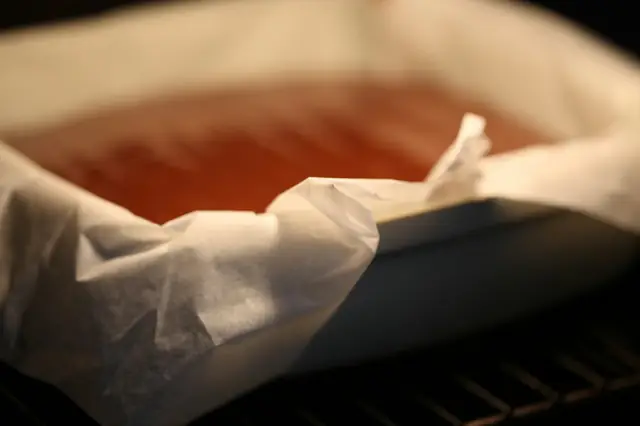 Know-how · 5 min readPan swaps: will a 9 x 13 recipe fit two 8 x 8 pans?Yes, with room to spare. Compare pan areas to see how deep the batter sits in two 8 x 8s, two rounds or one 9 x 9, and print a pan-area card for the drawer.Read the guide
 Practical note · 5 min readHow to measure a baking pan, and how much it holdsMeasure across the inside top edge, then the side height, then count cups of water to the rim. A worked 9 x 13, a table of common pans and a drawer card.Read the guide
 Know-how · 5 min readRound vs square pans: why a 9 inch round is about an 8 x 8A round pan's floor is 3.1416 × the radius squared, so a 9 inch round has 63.6 square inches and an 8 x 8 has 64. Swaps for 8, 9, 10 and 12 inch rounds.Read the guide
 Problem-solving guide · 6 min readHow to halve a recipe when the amounts get awkwardHalf of 1/3 cup, half of 3 eggs, half a can: turn each awkward amount into spoons you own. Includes a halving chart for the cupboard door.Read the guide
 Problem-solving guide · 6 min readDoubling a recipe for a crowd: the shopping-list sideFeeding 12 from a recipe for 4? Scale every line, total each ingredient across dishes, subtract the pantry and round up to packages once. Chart included.Read the guide
Keep planning
Related tools
- ScalePortion scaler with unit conversionScale a recipe up or down by servings or by pan size, see each amount in cups, tablespoons and grams, and print the scaled recipe card.Open the tool
- ScaleCups to grams converterTurn a recipe's cups and spoons into grams, or grams back into cups, for 53 ingredients from USDA data. Weigh it all into one bowl and print a weights card.Open the tool
- ScaleBatch cooking and freezer portion plannerList what you're cooking on batch day and see how many servings you'll make, what to eat fresh, how many freezer dinners and containers you need, and labels.Open the tool
- ScaleCost per serving calculatorPrice each ingredient from the package it comes in, add the lines and divide by the servings. Rice by the cup from a 5 lb bag works too. Print the cost card.Open the tool
- ScaleOven temperature converterConvert oven settings between °F and °C, rounded to your dial, then line up every dish's recipe time on one oven: when to preheat, change and put each in.Open the tool
Checked and dated
Sources
- NIST Handbook 44, 2026 edition, Appendix C: General Tables of Units of Measurement, National Institute of Standards and Technology. Checked October 10, 2026.
See every source on the site on the sources page. Spotted an error? Tell us.