Plan · Tool and printable
Four-night dinner rotation builder
Quick answer
Give four nights a fixed theme, like pasta on Monday and tacos on Tuesday, and write two to four dinners you already make under each one. Each week moves every theme night on to its next dinner. A theme with 3 versions brings each dinner back every 21 days, and the whole card repeats after the least common multiple of the counts. With 3, 2, 4 and 2 versions that is 11 dinners over 12 weeks.
Source: no outside figures. This tool works only from what you enter.
Try it
Filled in with the worked example below. Change any number and the result updates.
Your rotation 11 dinners on 4 theme nights. The whole card repeats every 12 weeks.
- Soonest any dinner comes back
- 14 days (Tuesday and Saturday)
- Open nights
- Wed, Fri, Sun, 3 right after a theme night
- Weeks on this card
- 4
Rotation card
| Week | Mon · Pasta night | Tue · Tacos or rice bowls | Thu · Soup or stew | Sat · Sheet-pan dinner |
|---|---|---|---|---|
| Week 1 | Spaghetti and meat sauce | Beef tacos | Chili | Sausage and peppers |
| Week 2 | Baked ziti | Chicken rice bowls | Chicken noodle soup | Chicken thighs and potatoes |
| Week 3 | Pesto pasta | Beef tacos | Lentil soup | Sausage and peppers |
| Week 4 | Spaghetti and meat sauce | Chicken rice bowls | Minestrone | Chicken thighs and potatoes |
How often each theme night repeats
| Theme night | Versions | Each one comes back | On this card |
|---|---|---|---|
| MondayPasta night | Spaghetti and meat sauce, Baked ziti, Pesto pasta | every 3 weeks (21 days) | up to 2 times each |
| TuesdayTacos or rice bowls | Beef tacos, Chicken rice bowls | every 2 weeks (14 days) | up to 2 times each |
| ThursdaySoup or stew | Chili, Chicken noodle soup, Lentil soup, Minestrone | every 4 weeks (28 days) | up to 1 time each |
| SaturdaySheet-pan dinner | Sausage and peppers, Chicken thighs and potatoes | every 2 weeks (14 days) | up to 2 times each |
The three open nights
- Wednesday: follows Tuesday's tacos or rice bowls, so it can be the leftover night
- Friday: follows Thursday's soup or stew, so it can be the leftover night
- Sunday: follows Saturday's sheet-pan dinner, so it can be the leftover night
What every week's shopping looks like
The theme nights keep the same dish types, so the list has the same shape each week. Only the version changes, so write its own items next to each line.
Produce (Mon, Tue, Thu, Sat)
- One vegetable to stir in (Pasta night, Mon)
- Salsa vegetables and lettuce (Tacos or rice bowls, Tue)
- Onion, carrot and celery (or a frozen soup mix) (Soup or stew, Thu)
- Two vegetables for roasting (Sheet-pan dinner, Sat)
Meat, seafood and tofu (Tue, Thu, Sat)
- Protein for the filling (Tacos or rice bowls, Tue)
- Protein for the pot (Soup or stew, Thu)
- Protein that roasts well (Sheet-pan dinner, Sat)
Dairy and eggs (Mon, Tue)
- Grated cheese (Pasta night, Mon)
- Shredded cheese (Tacos or rice bowls, Tue)
Bread and bakery (Tue, Thu)
- Tortillas (Tacos or rice bowls, Tue)
- Bread to serve (Soup or stew, Thu)
Pantry and dry goods (Mon, Tue, Thu, Sat)
- Dry pasta (Pasta night, Mon)
- Jarred or canned sauce base (Pasta night, Mon)
- Rice (Tacos or rice bowls, Tue)
- Broth (Soup or stew, Thu)
- Canned beans or tomatoes (Soup or stew, Thu)
- Oil and a seasoning blend (Sheet-pan dinner, Sat)
Step by step, no jargon
How to use this, in plain words
- 1
Look at a normal week and pick the four evenings when someone can cook. Those become your theme nights.
- 2
Give each of those nights a dish type that fits it. Pick something quick, like tacos or a stir-fry, for your busiest evening.
- 3
Under each theme, write the dinners your household already eats, one per line. Two is enough to start; you can add up to four.
- 4
Read the card. Each week moves every theme night to its next version, and the summary shows how soon a dinner comes back.
- 5
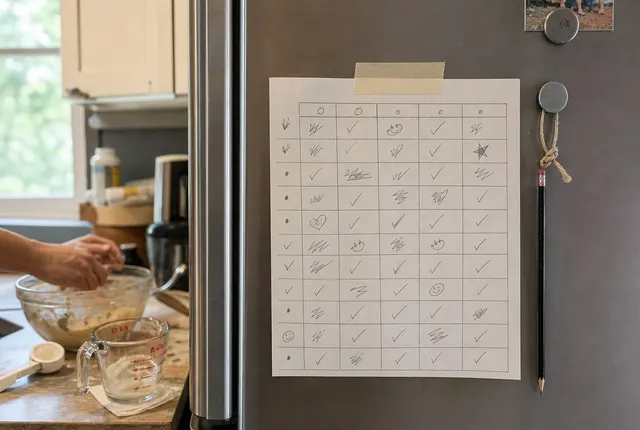
Print the card and stick it on the fridge. Each week, cross off the row you just finished.
Before you start
- Use dinners you already make. A rotation full of new recipes is hard to keep up past the first week or two.
- Put the theme on the night it suits. Soup can simmer on a slow evening; tacos fit the busy one.
- If someone groans at a dinner, give that night more versions. Four versions means each one comes back once a month.
- Keep the three open nights open. They absorb leftovers, a late practice or a night out without breaking the card.
The method
How it works
- Each theme night owns one day of the week and one dish type. You list up to 4 versions of it, the dinners your household already eats.
- Week 1 serves the first version on every theme night, week 2 the second, and so on. A night with fewer versions starts over sooner.
- A version comes back every (number of versions × 7) days. Two versions means every 14 days; four means every 28.
- The whole card repeats after the least common multiple of the four version counts. Counts of 2, 2, 2 and 2 repeat every 2 weeks; 3, 2, 4 and 2 repeat every 12.
- The other three nights stay open. An open night right after a theme night can take its leftovers; the rest suit an assemble or flex night.
Step by step
Worked example
A household keeps four theme nights: pasta on Monday (3 versions), tacos or rice bowls on Tuesday (2), soup or stew on Thursday (4) and a sheet-pan dinner on Saturday (2). They print 4 weeks at a time.
- Theme nights: Mon pasta night, Tue tacos or rice bowls, Thu soup or stew, Sat sheet-pan dinner.
- Versions on each night: 3, 2, 4, 2. Distinct dinners: 3 + 2 + 4 + 2 = 11.
- Each version comes back every (versions × 7) days: Mon 3 × 7 = 21, Tue 2 × 7 = 14, Thu 4 × 7 = 28, Sat 2 × 7 = 14.
- The whole card repeats after the least common multiple of 3, 2, 4, 2 = 12 weeks.
- Open nights: Wed, Fri, Sun. 3 of them follow a theme night and can take its leftovers.
Figure
Put it on the fridge
What to record
Your household
Variants
Just starting
Two versions on every night. The card repeats every 2 weeks and you only need 8 dinners you already know.
A month without repeats
Four versions on every night gives 16 dinners, and none comes back for 28 days. The card repeats every 4 weeks.
One anchor night
Keep one night with a single version, like pizza Friday, and rotate the other three. That night never changes, and the other three still rotate.
Two cooks in the house
Give each cook two of the four theme nights. Each one only has to know the versions on their own nights.
Limitations
- Planning estimate; check the family calendar each week and swap a theme night with an open night when the week changes.
- These are dish types and dinner names, not recipes. Quantities come from your own recipe.
- We don't give food storage times. For how long leftovers keep before an open night, check the USDA FoodKeeper app.
Checking the result
If the answer surprises you
The card repeats later than you expected? Uneven counts multiply. Versions of 3 and 4 only line up again after 12 weeks, which keeps the weeks from looking the same.
A dinner came back after only two weeks? That night has two versions. Add a third and it waits three weeks.
The shopping pattern doesn't show your dinners? It lists the parts of each dish type, not your recipe, so write your own items next to each line.
Asked often
Questions
What is a dinner rotation?
A short list of dinners you cycle through in a set order, so you stop deciding from scratch each week. Theme nights make it easier: Monday is always pasta, and only the kind of pasta changes.
Why four theme nights and not seven?
Four leaves three nights open for leftovers, an easy assembled dinner or eating out. A plan that fills all seven nights has no room for a late evening or a night out.
How many versions should each theme night have?
Start with two or three you already make. Each version comes back every (versions × 7) days, so three versions means each dinner returns every 21 days.
Why does the card take 12 weeks to repeat?
Each theme night restarts on its own schedule. The card only matches week 1 again when all four line up, which is the least common multiple of the version counts. For 3, 2, 4 and 2 that is 12.
Can an open night use leftovers from the night before?
Yes. The builder marks each open night that follows a theme night. We don't give storage times; for how long a food keeps, use the USDA FoodKeeper app.
Source: FoodKeeper App, FoodSafety.gov, checked October 6, 2026.
Read next
Guides that go deeper
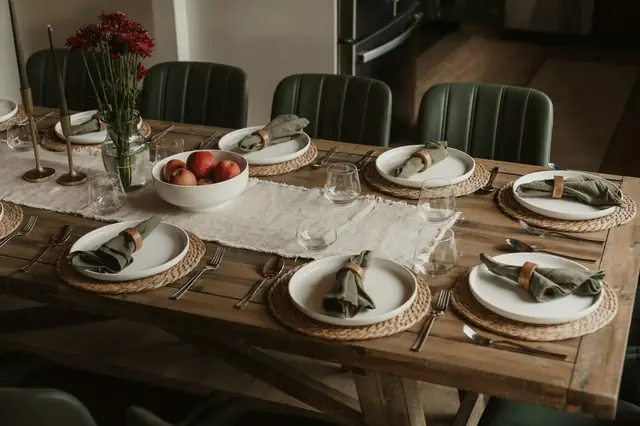 Know-how explainer · 6 min readTheme nights that actually last: four dish types instead of seven recipesTaco Tuesday wears thin by week three when it's always one taco. Pick four wide dish types, give each a few versions and rotate them weekly.Read the guide
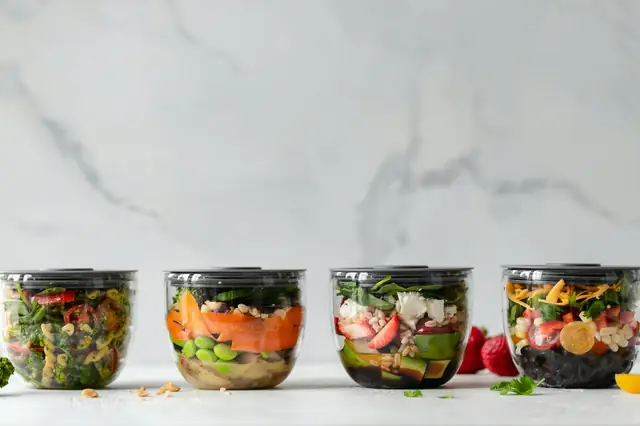 Problem-solving guide · 6 min readLeftover nights without the groans: how a double batch turns into a different dinnerNobody wants the same plate two nights running. Cook the base plain, split it before the sauce, and turn the second half into a different dinner.Read the guide
 Know-how explainer · 6 min readMeal planning for beginners: your first week in 20 minutesNew to meal planning? Plan one week of dinners in 20 minutes: check the calendar, look in the fridge, give each night a job and write one grocery list.Read the guide
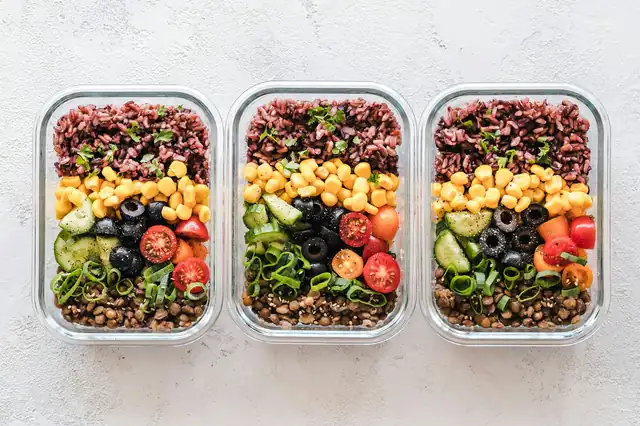 Problem-solving guide · 6 min readHow to plan a week of dinners when nobody agreesSettle the weekly dinner argument: find the overlap, give each night a job, take turns picking, and keep a flex night. Printable agreement sheet included.Read the guide
 Problem-solving guide · 6 min readGrocery bill keeps creeping up: a weekly routine that worksWhy grocery totals drift up week after week, and a short weekly routine to catch it: plan dinners, shop the pantry, buy from one list, log the receipt.Read the guide
The whole job
Systems that use this tool
This tool is one part of a finished routine. The system page puts it in order with the other steps.
 SystemRotations · 8 steps · free printableThe four-night theme rotation: one dinner card for the whole seasonFour theme nights, two to four dinners you already make under each, three open nights and one standing grocery list. Set it up once, reuse it all season.Open the system
 SystemHolidays and gatherings · 7 steps · free printableHalloween week dinners: fed and out the door before darkPlan Halloween week so dinner is eaten before trick-or-treating: cook earlier in the week, make the 31st an assemble night, shop once. Free printable.Open the system
 SystemWeekly planning · 7 steps · free printableThe weekly dinner system: plan the week in one sittingA once-a-week routine for weeknight dinners: check the calendar, give each night a job, shop once from one list and check the budget. Free printable.Open the system
 SystemWeekly planning · 7 steps · free printableGet weeknight dinners back on track in three weeksGet weeknight dinners back after summer or any break: map the new schedule, clear the fridge, plan three known dinners, then build up. Free printable.Open the system
Keep planning
Related tools
- FreezerFreezer inventory and labelsList what's in the freezer, see it sorted oldest first, count how many dinners the cooked dishes cover, and print an inventory sheet with labels.Open the tool
- PlanWeekly dinner plan generatorPlan seven dinners as cook, leftover, assemble and flex nights, rotate four dish types, and print the week with a grocery list by store section.Open the tool
- GroceryGrocery budget calculatorWork out a weekly and monthly grocery budget for your household from the USDA Food Plans cost tables, then print a monthly spending tracker.Open the tool
- GroceryPrice per unit calculatorCompare grocery prices by the ounce, pound, fluid ounce or item, including multi-packs and 2-for deals, then print a price book page.Open the tool
- PlanWeekly cooking-time budgetEnter when you get home and the minutes each dinner takes. See which nights run over, when to start, and what to move to a prep session or swap.Open the tool
Checked and dated
Sources
- FoodKeeper App, FoodSafety.gov (USDA Food Safety and Inspection Service). Checked October 6, 2026.
See every source on the site on the sources page. Spotted an error? Tell us.