Occasions · Tool and printable
School-lunch week planner
Quick answer
Count the lunches first: each child times the days they pack. Then, for each food, multiply the lunches it goes in by the amount per lunch, divide by the package size and round up to whole packages. In the worked example, two children pack 8 lunches, the bread takes 8 of 20 slices, and the priced foods come to $2.18 a lunch against a $3.25 school lunch.
Source: no outside figures. This tool works only from what you enter.
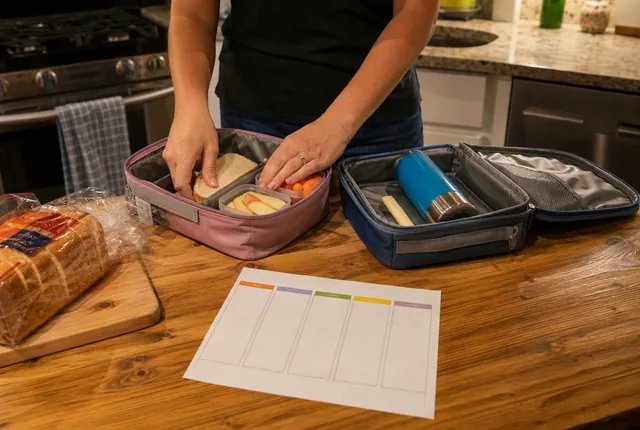
Try it
Filled in with the worked example below. Change any number and the result updates.
8 packed lunches this week Ava 5, Sam 3. The foods you priced come to $2.18 a lunch for what goes in the boxes, and $24.23 at the store for whole packages.
- Packed lunches
- 8
- Store trip
- $24.23
- Used this week
- $17.46
- Containers
- 6 washed nightly
Against buying at school: 8 lunches × $3.25 = $26. The packed foods used come to $17.46, so packing costs $8.54 less this week ($1.07 a lunch), or $256.2 over 30 school weeks at the same menu. Food cooked extra at dinner is counted in your dinner budget, not here. Numbers only, not advice.
The lunch week sheet
| Day | Child | In the box |
|---|---|---|
| Monday | Ava | Sandwich bread 2 slices, Sliced turkey 2 oz, Apples 1 each, Baby carrots 3 oz, Cheese sticks 1 each, Pretzels 1 oz, Water bottle 1 each |
| Monday | Sam | Sandwich bread 2 slices, Sliced turkey 2 oz, Apples 1 each, Baby carrots 3 oz, Cheese sticks 1 each, Water bottle 1 each |
| Tuesday | Ava | Pasta from dinner 1 cups, Apples 1 each, Baby carrots 3 oz, Cheese sticks 1 each, Pretzels 1 oz, Water bottle 1 each |
| Tuesday | Sam | Pasta from dinner 1 cups, Apples 1 each, Baby carrots 3 oz, Cheese sticks 1 each, Water bottle 1 each |
| Wednesday | Ava | Sandwich bread 2 slices, Sliced turkey 2 oz, Apples 1 each, Baby carrots 3 oz, Cheese sticks 1 each, Pretzels 1 oz, Water bottle 1 each |
| Thursday | Ava | Pasta from dinner 1 cups, Apples 1 each, Baby carrots 3 oz, Cheese sticks 1 each, Pretzels 1 oz, Water bottle 1 each |
| Thursday | Sam | Pasta from dinner 1 cups, Apples 1 each, Baby carrots 3 oz, Cheese sticks 1 each, Water bottle 1 each |
| Friday | Ava | Sandwich bread 2 slices, Sliced turkey 2 oz, Apples 1 each, Baby carrots 3 oz, Cheese sticks 1 each, Pretzels 1 oz, Water bottle 1 each |
The shopping list
| Food | Lunches | Needed | Buy | Left for next week | Cost |
|---|---|---|---|---|---|
| Sandwich breadmain, Mon Wed Fri | 4 | 8 slices | 1 package of 20 | 12 slices | $2.99 $1.2 used |
| Sliced turkeymain, Mon Wed Fri | 4 | 8 oz | 1 package of 9 | 1 oz | $4.49 $3.99 used |
| Pasta from dinnermain, Tue Thu | 4 | 4 cups | extra from dinner | ||
| Applesfruit, Mon Tue Wed Thu Fri | 8 | 8 each | 1 package of 8 | 0 each | $5.49 $5.49 used |
| Baby carrotsvegetable, Mon Tue Wed Thu Fri | 8 | 24 oz | 2 packages of 16 | 8 oz | $3.98 $2.99 used |
| Cheese stickssnack, Mon Tue Wed Thu Fri | 8 | 8 each | 1 package of 12 | 4 each | $4.29 $2.86 used |
| Pretzelssnack, Mon Tue Wed Thu Fri | 5 | 5 oz | 1 package of 16 | 11 oz | $2.99 $0.93 used |
| Water bottledrink, Mon Tue Wed Thu Fri | 8 | 8 each | already have |
"Buy" rounds up to whole packages, so some is left for next week; "used" is the share of each package this week's lunches eat. How long packed food keeps, and whether a lunch needs an ice pack, are food safety questions: see FoodKeeper and FoodSafety.gov. This sheet does the counting.
The packing countdown
Before the weekone store trip
- Buy: Sandwich bread × 1, Sliced turkey × 1, Apples × 1, Baby carrots × 2, Cheese sticks × 1, Pretzels × 1.
Sunday eveningfor Monday
- Pack 2 boxes for Monday: Ava and Sam.
Monday eveningfor Tuesday
- At dinner on Monday, cook 2 cups extra of Pasta from dinner for Tuesday.
- Pack 2 boxes for Tuesday: Ava and Sam.
Tuesday eveningfor Wednesday
- Pack 1 box for Wednesday: Ava.
Wednesday eveningfor Thursday
- At dinner on Wednesday, cook 2 cups extra of Pasta from dinner for Thursday.
- Pack 2 boxes for Thursday: Ava and Sam.
Thursday eveningfor Friday
- Pack 1 box for Friday: Ava.
Step by step, no jargon
How to use this, in plain words
- 1
Type each child's name and tick the days they take a lunch from home. Leave a day empty when they buy at school, have a field trip lunch, or are off.
- 2
Write what goes in the boxes, one food per line. A sandwich is two lines, the bread and the filling. Tick the days each food goes in, and set "For" when only one child eats it.
- 3
Type how much goes in one lunch and the package size from the label, in the same unit: slices, ounces, cups or pieces. Add the package price if you want the cost.
- 4
Mark foods that come from dinner as "Extra from dinner". The countdown then tells you how much more to cook the night before.
- 5
Read the week sheet and the shopping list, type your district's school lunch price for the comparison, then print the sheet for the fridge.
Before you start
- Check the school menu before you tick days. If a child would rather buy on pizza day, leave that day unticked; every count on the sheet changes with it.
- Read package sizes in the unit you pack by. Count the slices in a loaf once, and take the ounces off the front of the deli pack.
- Count your containers and lids before the week starts. The sheet shows how many you need if you wash them every night.
- How long packed food keeps and whether a lunch needs an ice pack are food safety questions. Look them up on FoodSafety.gov and in the FoodKeeper app; this page only counts.
The method
How it works
- Packed lunches = the days ticked for each child, added up.
- Each food: lunches it goes in = the children packing on each day it's ticked (or only the child it's for), added up. Amount needed = lunches × amount per lunch.
- Packages to buy = amount needed ÷ package size, rounded up. Left for next week = packages × package size − amount needed.
- Cost used = amount needed × package price ÷ package size. Cost per lunch = all the cost used ÷ packed lunches. The store trip is packages × price, which is more because whole packages carry over.
- Against school lunch: school price × packed lunches − cost used = the weekly difference. Times the school weeks you type gives the stretch total, at the same menu.
- Containers: washed every night = containers per lunch × the most boxes on any one day. Washed once a week = containers per lunch × all the packed lunches.
Step by step
Worked example
Two children. Ava packs all five days; Sam packs Monday, Tuesday and Thursday and buys at school on Wednesday and Friday. Sandwich days are Monday, Wednesday and Friday (2 slices of bread and 2 oz of turkey each); Tuesday and Thursday take a cup of pasta cooked extra at dinner the night before. Every box gets an apple, 3 oz of baby carrots, a cheese stick and a water bottle from home; Ava also gets 1 oz of pretzels. Prices are sample store prices, no chain named. The school lunch is $3.25, compared over 30 weeks. Three containers go in each lunch and get washed every night; lunches are packed the night before.
- Lunches: Ava packs 5 and Sam packs 3, so 8 packed lunches. Some days have two boxes and some have one.
- Sandwich days (Mon, Wed, Fri) have 4 lunches between them: 4 × 2 slices = 8 slices, 1 loaf of 20 with 12 left for next week. Turkey: 4 × 2 oz = 8 oz, 1 pack of 9 with 1 oz left.
- Every-day foods go in all 8 boxes: carrots 8 × 3 oz = 24 oz, which takes 2 bags of 16 and leaves 8 oz. Pasta on Tue and Thu: 4 lunches × 1 cup = 4 cups, cooked as 2 extra cups at Monday and Wednesday dinner.
- Cost: $24.23 at the store for whole packages; the share used this week is $17.46, or $17.46 ÷ 8 = $2.18 a lunch.
- School lunch at $3.25: 8 × $3.25 = $26. $26 − $17.46 = $8.54 a week, × 30 weeks = $256.2. Containers: 3 per lunch × 2 boxes on the busiest day = 6, washed each night.
Figure
Put it on the fridge
What to record
Print your filled-in sheet from the button under the result, or print a blank one and fill it in by hand. It has a week block and a shopping block:
- Week of (date) and who packs which days
- Day, child and what goes in the box
- Food, lunches it goes in and amount needed
- Packages to buy and what's left for next week
- Cost of the trip and cost used per lunch
- Extra to cook at dinner, and which night
- Containers per lunch and when they get washed
- Notes for next week (what came home uneaten)
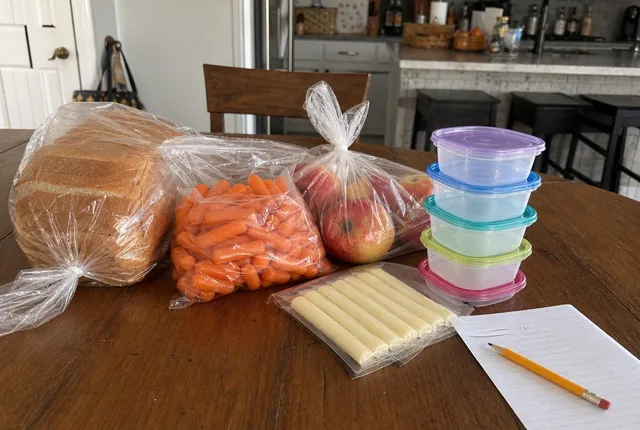
Your household
Variants
Leftovers in a thermos
Mark a main as "Extra from dinner" and tick its days. The countdown asks for the extra the evening before, so the dinner plan and the lunch plan share one pot. The leftover route map plans the dinner side of it.
One child, part of the week
Tick only the days that child packs. When a loaf or a deli pack covers more lunches than the week has, the sheet shows the rest as left for next week.
Different boxes for different children
Set "For" on a line to one child. Shared foods stay on "Everyone", so one package still covers both boxes and the shopping list adds them together.
Price the snacks two ways
Add the same snack twice, once as single packs and once as a big bag, each on its own day pattern, and compare the "used" cost. The price per unit calculator does the shelf-tag check in the store.
Limitations
- Planning estimate; check package sizes on your labels and the school price with your district. The sample prices in the worked example are not from any one store.
- The comparison counts only the foods you price. Food cooked extra at dinner sits in the dinner budget, and containers, bags and ice packs aren't counted.
- This page does counts and costs only. It gives no keeping times, no ice-pack rules and no nutrition advice; for keeping times use the USDA FoodKeeper app and FoodSafety.gov.
Checking the result
If the answer surprises you
The store trip costs more than the week? Whole packages carry over. A loaf of 20 slices with 8 used this week means 12 slices are already paid for next week, so the "used" figure is the fair cost per lunch.
Packing doesn't come out cheaper? Snack packs and single-serve drinks can cost more per ounce than the big bag or jug. Try the same food in a bigger package and portion it into containers.
A child's day is flagged with no main? Every box needs one line in the Main part. Tick a main for that day, or untick the day if that child buys at school.
Asked often
Questions
How do I plan school lunches for the week?
Start with the days each child packs, then fill one line per food with the days it goes in. Multiply the lunches by the amount per lunch, round up to whole packages, and shop once before the week. Pack each box the night before from the printed sheet.
Is packing lunch cheaper than buying school lunch?
It depends on your menu and your district's price, which is why the tool asks for both. In the worked example, the foods used come to $17.46 for 8 lunches, or $2.18 each, against $3.25 at school: $8.54 a week less. Snack packs and single drinks can flip that, so price your own list.
How much bread do I need for a week of sandwiches?
Two slices per sandwich, times the sandwich lunches. In the worked example, sandwiches go in on Monday, Wednesday and Friday, Ava packs all three and Sam only Monday. That's 4 sandwich lunches and 8 slices: one 20-slice loaf with 12 left over.
How many lunch containers do I need?
If you wash them every night, the containers in one lunch times the most children packing on the same day. If you wash once a week, multiply by every packed lunch in the week. Three containers a lunch and two children is 6 for nightly washing.
How long can a packed lunch sit before school lunch time?
That's a food safety question, and this page doesn't answer it. FoodSafety.gov covers packed lunches and ice packs, and the FoodKeeper app has keeping times for each food.
Source: FoodKeeper App, FoodSafety.gov, checked October 6, 2026.
Read next
Guides that go deeper
 Problem-solving guide · 6 min readIs packing lunch cheaper than buying school lunch?Set the food a packed lunch uses against your school's price. A worked week: $2.18 a packed lunch vs $3.25 at school, and how snack packs shrink the gap.Read the guide
 Know-how · 5 min readMy child buys lunch on pizza day. How do I plan the rest of the week?Untick the days a child buys at school and the lunch sheet recounts. What a part-week does to the shopping list, the leftovers and the week's lunch money.Read the guide
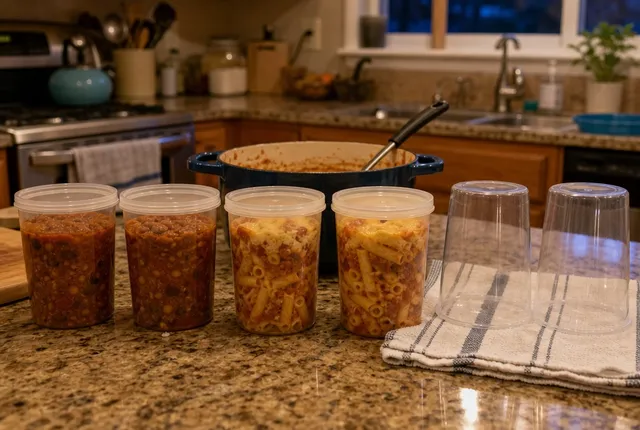 Problem-solving guide · 6 min readLeftovers for lunch all week: how much to cook, and how many containers two people needTwo people packing weekday lunches need 10 servings. Cook each dinner for the table plus the lunches until the next cook night, and keep about 6 containers.Read the guide
 Problem guide · 6 min readIs the bulk size really cheaper? When the big bag losesThe big bag has the lower unit price, but you pay for the whole bag. Work out how much you must use for it to win, and spot sales and multi-packs that flip it.Read the guide
 Know-how · 5 min readUnit price: how to compare sizes in the store in 10 secondsRead the unit price on the shelf tag, fix mismatched units in your head, and spot when the bigger package loses. Includes a pocket card to print.Read the guide
Keep planning
Related tools
- Cook onceLeftover route mapList what's cooked in your fridge and the lunches and leftover nights ahead. The map sends each serving to a meal, oldest first, and shows what's still open.Open the tool
- PlanWeekly dinner plan generatorPlan seven dinners as cook, leftover, assemble and flex nights, rotate four dish types, and print the week with a grocery list by store section.Open the tool
- GroceryPrice per unit calculatorCompare grocery prices by the ounce, pound, fluid ounce or item, including multi-packs and 2-for deals, then print a price book page.Open the tool
- GroceryPantry-first grocery listList what the week's dinners need, enter what's already on the shelf, and get a store list of only the gap, rounded up to whole packages.Open the tool
- OccasionsParty food quantity calculatorType your guest count and menu. Get pounds, pieces and gallons for each dish from Iowa State Extension's per-guest table, plus a printable quantity sheet.Open the tool
Checked and dated
Sources
- FoodKeeper App, FoodSafety.gov (USDA Food Safety and Inspection Service). Checked October 6, 2026.
See every source on the site on the sources page. Spotted an error? Tell us.