Cook once · Tool and printable
Cook once, eat three planner
Quick answer
Add up how much of the base each dinner uses: people at the table times how much of the plate it fills. Divide by what your recipe serves and round up to the nearest half batch. In the worked example a family of 4 needs 8 servings of shredded chicken for tacos, soup and fried rice. The recipe serves 6, so they make it 1½ times, buy 4.5 lb of thighs instead of 3, and pack 4, 2 and 2 servings in three containers with 1 spare.
Source: no outside figures. This tool works only from what you enter.
Try it
Filled in with the worked example below. Change any number and the result updates.
Cook once on Sunday Make the shredded chicken recipe 1.5 times: 9 servings for the 8 servings the week needs (1 over). Buy 4.5 lb boneless chicken thighs (2.04 kg). Servings of base per dinner: Monday Chicken tacos 4, Wednesday Chicken noodle soup 2, Friday Chicken fried rice 2.
- Sunday
- 75 min for the base
- Dinner nights
- 65 min across 3 nights
- Containers
- 4
The week from Sunday
- SunCook the shredded chicken
- MonChicken tacos
- Tueother dinner
- WedChicken noodle soup
- Thuother dinner
- FriChicken fried rice
- Satother dinner
One container per dinner
| Dinner | Base fills | Servings of base | Share of the batch | Container | Where it waits | Weeknight minutes |
|---|---|---|---|---|---|---|
| Chicken tacos Monday, 1 day after | the main part | 4 (4 × 1) | 44% | 4 cups (946 mL) | check FoodKeeper | 15 min |
| Chicken noodle soup Wednesday, 3 days after | half the plate | 2 (4 × 0.5) | 22% | 2 cups (473 mL) | check FoodKeeper | 30 min |
| Chicken fried rice Friday, 5 days after | half the plate | 2 (4 × 0.5) | 22% | 2 cups (473 mL) | check FoodKeeper | 20 min |
| Spare from rounding up | lunch or seconds | 1 | 11% | 1 cup (237 mL) | your call |
The last dinner is 5 days after cooking. Look the base up in the USDA FoodKeeper app, and if its fridge time is shorter, enter that number above and the tool sends the later containers to the freezer.
Labels to cut out and tape on
Write the date on each label the day you cook. The use-by line is left blank on purpose: copy it from the USDA FoodKeeper app.
- Shredded chickenMonday: Chicken tacos · 4 servings · 4 cupsCooked: Use by:
- Shredded chickenWednesday: Chicken noodle soup · 2 servings · 2 cupsCooked: Use by:
- Shredded chickenFriday: Chicken fried rice · 2 servings · 2 cupsCooked: Use by:
- Shredded chickenSpare · 1 serving · 1 cupsCooked: Use by:
Step by step, no jargon
How to use this, in plain words
- 1
Pick one base you already cook well: shredded chicken, a pot of beans, browned ground beef, a tray of roast vegetables. Copy what the recipe serves and its main ingredient, like the pounds of chicken.
- 2
Choose your cooking day and the three dinners that will use the base. Make them different on purpose: one where it is the star, then a soup, a rice dish or a wrap.
- 3
For each dinner, say how much of the plate the base fills. Taco filling is the main part. In a soup with noodles it is about half.
- 4
Read the batch number and the shopping amount, and change the main ingredient on your grocery list before you go.
- 5
After cooking, measure the base in a big measuring cup, type in the cups, then print the card and labels. Fill in the use-by line yourself from the USDA FoodKeeper app.
Before you start
- Keep the base plain. Season it lightly on cooking day and add the taco spices, the soup herbs or the soy sauce on each dinner night, so three dinners don't taste like one.
- Put crisp dinners like tacos first in the week and saucy ones like soup or fried rice later.
- Check that you have one container per dinner, plus one for the spare, and that they fit on one fridge shelf.
- Look the base up in the USDA FoodKeeper app before you pick the last dinner's day. If the last dinner is later than its fridge time, enter that number and the planner sends that container to the freezer on cooking day.
The method
How it works
- Servings of base for a dinner = people at dinner × how much of the plate the base fills (1 for the main part, ¾, ½ when it is mixed with other things, ¼ for a topping).
- Servings needed = the dinners added together + any spare servings you ask for.
- Batches = servings needed ÷ what one batch of the recipe serves, rounded up to the nearest half batch. Servings made = recipe serves × batches.
- Shopping = the main ingredient for one batch × batches. Pounds to kilograms at 1 lb = 453.59237 g, ounces at 1 oz = 28.349523125 g, cups at 1 cup = 8 fl oz, about 237 mL.
- With a measured yield: cups a serving = cooked yield in cups ÷ servings made, and each container gets its servings × cups a serving. Share of the batch = the dinner's servings ÷ servings made.
- Days after cooking = days from the cooking day to each dinner. If you enter a fridge-days number from USDA FoodKeeper, any dinner later than that is marked for the freezer.
Source: NIST Handbook 44 (2026), Appendix C, checked October 10, 2026; FoodKeeper App, FoodSafety.gov, checked October 6, 2026.
Step by step
Worked example
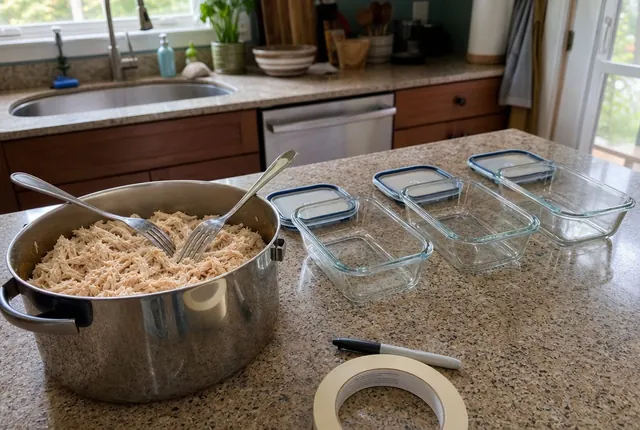
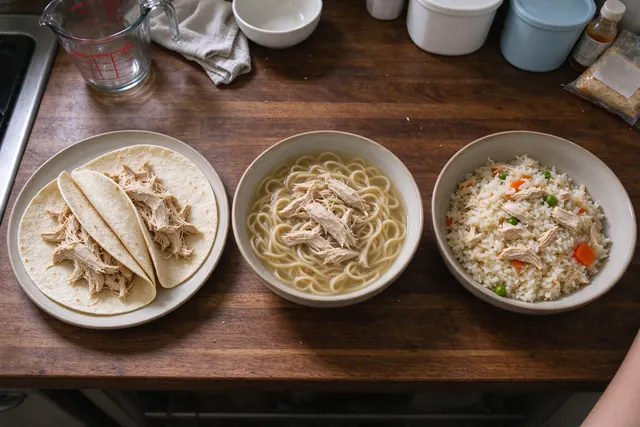
A family of 4 cooks a big pot of shredded chicken on Sunday afternoon. Their usual recipe serves 6 and uses 3 lb of boneless chicken thighs. They want chicken tacos on Monday, chicken noodle soup on Wednesday and chicken fried rice on Friday. In the soup and the rice the chicken is about half of each bowl. After cooking they measure the shredded chicken: 9 cups.
- Servings of base each dinner needs = people × how much of the plate it fills: Chicken tacos 4 × 1 = 4; Chicken noodle soup 4 × 0.5 = 2; Chicken fried rice 4 × 0.5 = 2. Together, 8 servings.
- Batches = 8 ÷ 6 (what the recipe serves) = 1.33, rounded up to the nearest half recipe: 1.5. That makes 6 × 1.5 = 9 servings, 1 more than needed.
- Shopping: 3 lb for one batch × 1.5 = 4.5 lb (2.04 kg).
- Split by the measured yield: 9 cups ÷ 9 servings = 1 cup a serving. Chicken tacos gets 4 × 1 = 4 cups, 44% of the batch.
- Days from Sunday: Monday 1, Wednesday 3, Friday 5. The last container waits 5 days; check that against USDA FoodKeeper.
- Weeknight time: 15 + 30 + 20 = 65 minutes across 3 dinners, after 75 minutes on Sunday.
Figure
Put it on the fridge
What to record
Your household
Variants
Cook once, eat twice
Leave the third dinner line empty. Utah State University Extension's meal-planning handout suggests exactly this: cook once, eat twice. It is the easiest place to start.
Source: Meal Planning 101, Utah State University Extension, checked October 12, 2026.
A pot of beans
Cook dry beans on the weekend and plan burritos, a bean soup and a rice bowl. Set the main ingredient to the pounds of dry beans and the shopping line scales the bag.
Two bases at once
Run the planner twice, once for a protein and once for a grain or a tray of roast vegetables, with the same dinner days. Each base gets its own containers and labels.
Cooking for one or two
With 1 or 2 people at the table, a full recipe often covers more than three dinners. The planner drops to half a batch when that is enough, and anything over goes in the spare container.
Published figures
Numbers this tool uses
| Figure | Value | Source, date checked |
|---|---|---|
| 1 pound | 453.59237 grams | NIST Handbook 44 (2026), Appendix C, October 10, 2026 |
| 1 ounce | 28.349523125 grams | NIST Handbook 44 (2026), Appendix C, October 10, 2026 |
| 1 cup | 8 US fluid ounces, about 237 mL | NIST Handbook 44 (2026), Appendix C, October 10, 2026 |
| Cook once, eat twice | Plan to use your leftovers (meal-planning tip) | Meal Planning 101, Utah State University Extension, October 12, 2026 |
Limitations
- Planning estimate; check your recipe's own servings and measure your cooked yield, since servings and cooked weights differ from recipe to recipe and from house to house.
- Batches round up to the nearest half recipe, so the planner can make up to half a batch more than the week needs.
- This page counts and splits servings only. It doesn't say how long cooked food keeps in the fridge or freezer, or how to cool, reheat or thaw it. For those, use the USDA FoodKeeper app and FoodSafety.gov.
Checking the result
If the answer surprises you
More servings than you need? The planner rounds up to the nearest half batch, since most recipes halve easily and thirds get awkward. The extra goes in the spare container for a lunch.
The shopping amount looks big? It is one batch's main ingredient times the batches. If the store sells it in fixed packs, round to the pack and use the pantry-first list to see what is left over.
A container looks small in cups? Its size comes from your measured yield. A base that cooks down, like ground beef, gives fewer cups than you expect.
Asked often
Questions
What does cook once, eat three mean?
You cook one base, like shredded chicken or a pot of beans, in a bigger batch on one day, then turn it into three different dinners later in the week. One night it is the main part of the plate; on the other nights it goes into something else, like soup or fried rice.
How much chicken do I need for three dinners?
Count servings, not pounds. Multiply the people at your table by how much of each plate the chicken fills, add the three dinners together, then divide by what your recipe serves. For 4 people with tacos, soup and fried rice that is 4 + 2 + 2 = 8 servings, so a recipe that serves 6 from 3 lb is made 1½ times: 4.5 lb.
Why does it round up to a half batch?
Most recipes halve cleanly and few split into thirds. Rounding up to the nearest half keeps the arithmetic simple, and the spare servings go in their own container for a lunch.
How long does the cooked base keep in the fridge?
We don't give storage times. Look your base up in the USDA FoodKeeper app, type its fridge time into the planner, and any later dinner is marked for the freezer. The labels leave the use-by line blank so you can write your own date.
Source: FoodKeeper App, FoodSafety.gov, checked October 6, 2026.
How is this different from the batch cooking planner?
The batch cooking planner fills the freezer with whole dishes for the weeks ahead. This page is for one week: one base, cooked once, that becomes several different dinners in the next few days.
Read next
Guides that go deeper
 Problem-solving guide · 6 min readLeftover nights without the groans: how a double batch turns into a different dinnerNobody wants the same plate two nights running. Cook the base plain, split it before the sauce, and turn the second half into a different dinner.Read the guide
 Know-how · 5 min readWhat size container for one dinner? Measuring a batch in cupsMeasure the batch in cups once, divide by the servings and multiply by the people at your table. That gives cups per dinner, and the container size follows.Read the guide
 Problem-solving guide · 6 min readFive dinners from one grocery trip: how to plan the week so the list holdsCook three nights, eat five: double two bases, put the fresh dinners first and the pantry ones last, and keep one shelf dinner as the backup.Read the guide
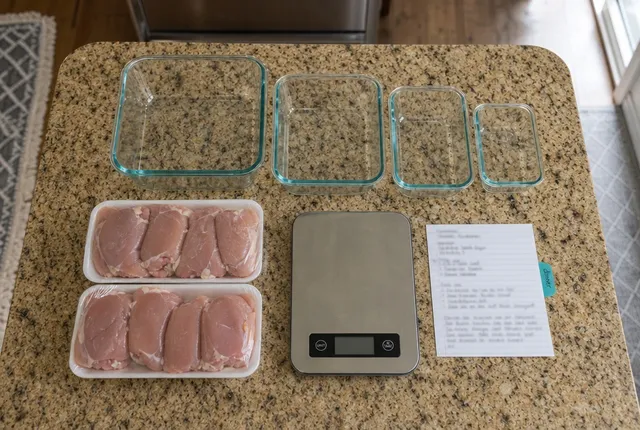 Problem-solving guide · 6 min readHow much shredded chicken for a week of dinners: count servings, not poundsBuying 2 lb per dinner leaves a tub of chicken nobody eats. Count servings for each dinner, add them up, then round the recipe up by half batches.Read the guide
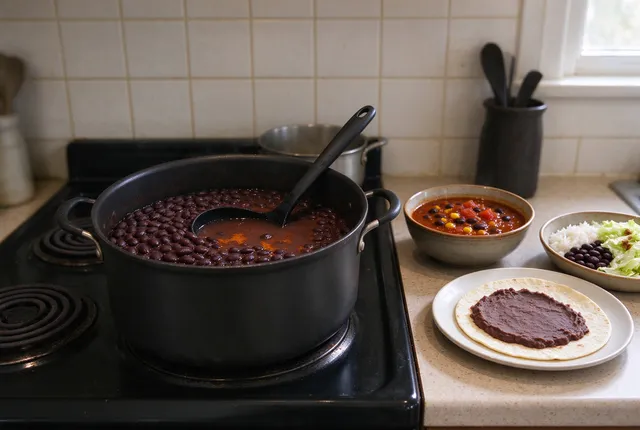 Know-how · 6 min readThree dinners from one pot of beans that don't taste like the same dinnerCook the pot plain, then send each part in a different direction: one soupy, one mashed, one in a bowl. Plus how many cups to cook and how many cans that is.Read the guide
The whole job
Systems that use this tool
This tool is one part of a finished routine. The system page puts it in order with the other steps.
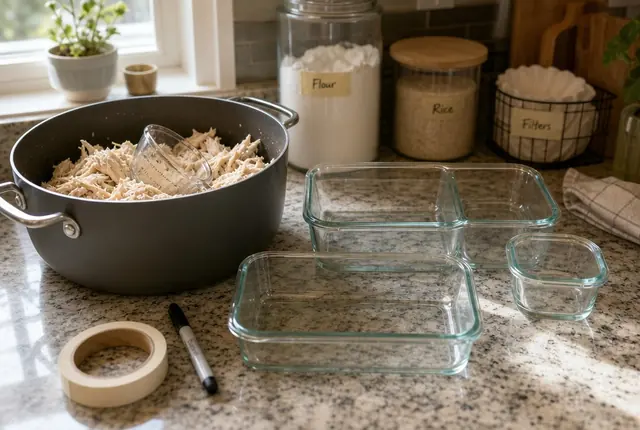 SystemWeekly planning · 8 steps · free printableCook once, eat twice: one big batch, two or three dinnersPick one plain base, count servings for every dinner it feeds, cook it once, split it before the sauce and route the rest by date. Free double-batch card.Open the system
 SystemWeekly planning · 8 steps · free printableWeeknight time budget: put each dinner on the night that has time for itWrite when you get home, split each dinner into hands-on and hands-off minutes, fix the nights that run over and post start times. Free time budget sheet.Open the system
Keep planning
Related tools
- FreezerFreezer meal-prep day plannerList your freezer meals and get a prep-day timeline for one oven, the stove and a slow cooker, plus the containers, labels and a freezer-load check.Open the tool
- PlanWeekly dinner plan generatorPlan seven dinners as cook, leftover, assemble and flex nights, rotate four dish types, and print the week with a grocery list by store section.Open the tool
- ScaleBatch cooking and freezer portion plannerList what you're cooking on batch day and see how many servings you'll make, what to eat fresh, how many freezer dinners and containers you need, and labels.Open the tool
- ScalePortion scaler with unit conversionScale a recipe up or down by servings or by pan size, see each amount in cups, tablespoons and grams, and print the scaled recipe card.Open the tool
- GroceryPantry-first grocery listList what the week's dinners need, enter what's already on the shelf, and get a store list of only the gap, rounded up to whole packages.Open the tool
- FreezerFreezer inventory and labelsList what's in the freezer, see it sorted oldest first, count how many dinners the cooked dishes cover, and print an inventory sheet with labels.Open the tool
- ScaleCost per serving calculatorPrice each ingredient from the package it comes in, add the lines and divide by the servings. Rice by the cup from a 5 lb bag works too. Print the cost card.Open the tool
- Cook onceLeftover route mapList what's cooked in your fridge and the lunches and leftover nights ahead. The map sends each serving to a meal, oldest first, and shows what's still open.Open the tool
- PlanWeekly cooking-time budgetEnter when you get home and the minutes each dinner takes. See which nights run over, when to start, and what to move to a prep session or swap.Open the tool
Checked and dated
Sources
- NIST Handbook 44, 2026 edition, Appendix C: General Tables of Units of Measurement, National Institute of Standards and Technology. Checked October 10, 2026.
- Meal Planning 101: quick tips (Create Better Health, week 2 handout), Utah State University Extension, Create Better Health (SNAP-Ed). Checked October 12, 2026.
- FoodKeeper App, FoodSafety.gov (USDA Food Safety and Inspection Service). Checked October 6, 2026.
See every source on the site on the sources page. Spotted an error? Tell us.